A Day on Dartmoor

I remember, years ago, I saw the film Wuthering Heights starring Laurence Olivier. It was set in the moors and I remember they were painted as these dark, frightening places; the movie was in black and white, after all. The first time I visited Dartmoor I was more than a bit surprised that the moors of my imagination and the moors of reality are decidedly different things. There are many villages and towns in Dartmoor and one day we took a ride to explore them.

Our first stop was Bovey Tracey, a small market town whose location gives rise to the slogan used on the town's boundary signs: The Gateway to the Moor.
An established Saxon community, its name appears in the Doomsday book of 1086 as Bovi. The Tracey part of the name comes from the Tracey family who were lords of the manner following the Norman conquest. (One member of the Tracey family was implicated in the murder of Thomas a Becket in Canterbury!)
It's a pretty little town

and it has a marvelous art center, The Riverside, which is the home of the Devon Guild of Craftsmen.

There's pottery, jewelry, fiber arts, prints, and ceramics to die for in the shop, which is enormous. The large main room exhibits many different media. I could easily have spent thousands there.

I had two favorites in the current exhibition. One was a wood block print called Murmuration by Merlyn Chesterman.

The other was The Song of the Warbler by Jane Witheridge, which is a painting on silk. I used to do silk painting years ago and was really impressed by her use of black resist.

Check out their websites for more wonderful images.
Across the street is a park with a little stream running through it - future inspiration for a painting or something.

Next it was off to the little village of Lustleigh. There have been settlements in that area since the Stone Age. Scholars disagree about its identity; some say it was named in the will of King Alfred as Suðeswyrðe, later recorded in the Doomsday book as Sutreword. Whatever its past identities, it is now known for its thatched buildings, the most famous of which is the pub, The Cleave.

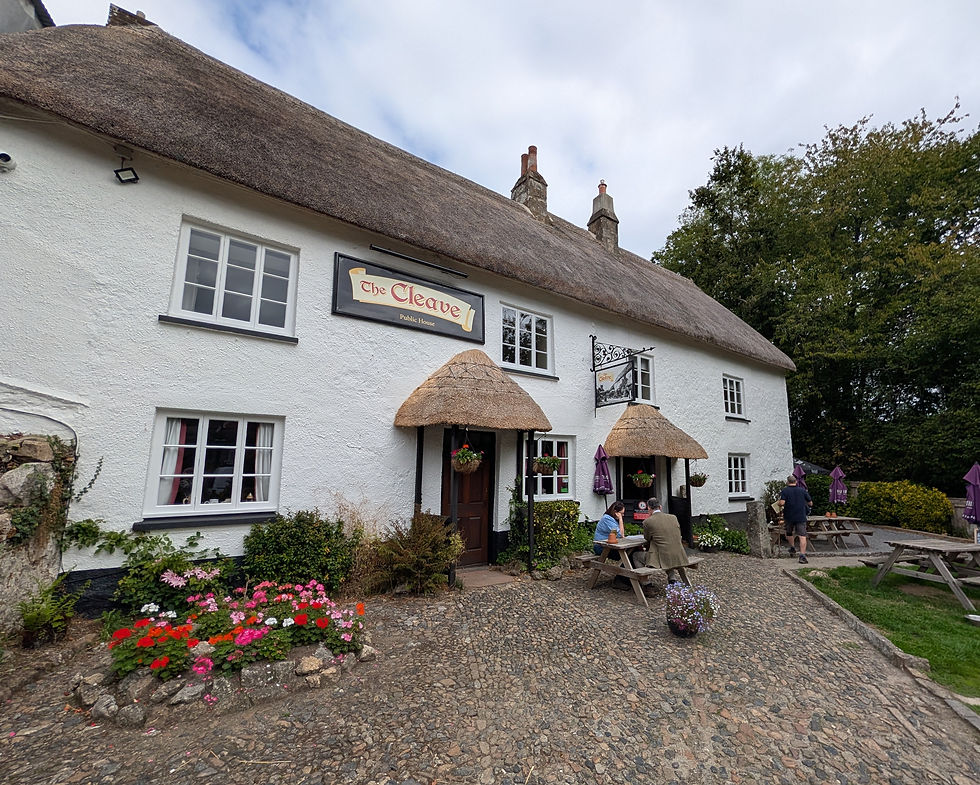
The building that holds The Cleeve was built in the 15th century and is a Grade II listed building (meaning the owners have to petition and jump through hoops to make any improvements to it.) It still has single glazed windows and stone walls, so I'll bet it's very cold in the winter. Happily, it has a large hearth in the bar area, where we enjoyed lunch.

Lustleigh is the home of the Parish Church of St. John the Baptist.

The first part of the church, the chancel, was built in 1250; most of the rest was added in the 15h or early 16th century. The church yard is oval shaped, indicating that it was probably used as a graveyard by the Romans. This conjecture is supported by the presence of the Lustleigh Inscribed Stone in the north aisle, dating from around 450–600 AD. We entered the stone portico

and were happy to find the church open for visitors.
It's really a lovely church and is filled with some incredible items.


I was really pleased that, on a screen near the entrance, there are laminated guides to some of the items in the church. These are most helpful, though nearly impossible to read in the darkness of the church. I photographed them which made them far easier to decipher. Whoever wrote them has a way with words and a marvelous sense of humor. In describing the long stone porch he wrote,
“The seating (in the porch) was for villagers to swear oaths, organize business deals, arrange marriages, and even get married, which did not happen in a church back then. Marriage was more of a formal social business arrangement then, the wealthier might spring for a Marriage Mass afterwards, or just a blessing, but a romantic love match… Well, as old Billy Shakespeare’s Romeo and Juliet points out, in the culture of the time that was a rubbish idea.”
There's a Norman font, though it’s not entirely Norman.

The inner pedestal is, but the carved bowl looks to be more modern and the pillars holding the bowl are surely 19th century. As the sign says, “A speculation, for sure, but worth a bob or two.”
The Lustleigh Inscribed stone, aka Dactuidoc's Stone is a tall pillar of granite inscribed in Latin.

There are three stone effigies or memorials in the north and south transepts from the early 14h century, two of the three are pictured below.


The wooden pulpit was carved in 1904 by Herbert Read.

The guide describes it thus:
“The design is from the many medieval pulpits that inhabit Devon's churches, over a hundred and eighty, I believe; those ornately carved columns, the intricate canopies over the figures, the vine frieze across the top, Devon Traditional boasting at its best. The figures are the only bow to modernity, five of them representing Christ in his guise as guide, shepherd, sower, fisherman, and priest, though a couple of saints get in on the act, too.”
My favorite bits were the carved pew ends
Again, from the guide,
“From the twentieth century come the benches and bench ends, an outstanding collection of local and religious imagery; admittedly there is an elephant and a unicorn in the mix, but after a pint or ten of Stanbury's Old Devon Cider, who knows what we will see?”
The church bells and their ringers are quite famous. In 1553, the inventory of church goods lists Lustleigh as having four bells. A fifth bell was added in 1875 and a sixth in 1890. They were all recast in 1923 and overhauled in 2008. The bell ringers have won many competitions.
A sign at the church gate indicates that the steps to the gate were placed to commemorate the jubilee of Queen Victoria.

Such a lovely village but with so little parking I wonder how they manage at the height of tourist season.
On our way to the last pub in Bruce's collection, we rode through the heart of Dartmoor. This was my favorite part of the day because of the animals. There are signs all along the rode advising motorists to drive slowly and carefully and watch out for animals in the road. We hit the jackpot – but no animals, in case you were worried.


We stopped at The Warren House Inn, the pub with the highest elevation in southern England. Local legend says that the fire in the hearth has been burning continuously since 1845, when it was built. There were a few smoking embers when we were there.

Those things hanging on the fireplace are called horse brasses. Originally created in the mid-19th century, these decorative plaques were used to adorn the leather harnesses and martingales of working heavy horses, like Shires and Clydesdales. They served as a status symbol for horse owners and carters, and historically acted as pagan-rooted lucky charms to ward off evil spirits, illness, and horseflies. When motor vehicles replaced working horses, landowners gave the brasses to pub owners for decoration and, presumably, to keep evil spirits out of the pubs.
After a half pint for Bruce,

a coffee for me, and a lovely chat with the owner, we were off across the moor again, headed for home.


It's a gorgeous part of the country. No wonder we come back year after year.


Comments