All Roads Lead to Broadway
- chirp54
- Dec 1, 2025
- 4 min read
That's what they say in New York. It's pretty accurate in Worcestershire, too, because a short drive into the Cotswolds takes you to the pretty village of Broadway.

With a bustling high street, it's a wonderful place to spend the day. We parked the car and walked to the Broadway museum, which is dedicated to preserving and celebrating its history and cultural significance.

There are a number of story boards that tell of the importance of Broadway as a station for the coaches that traveled from London, along with examples of some of the associated trades.

One room is set up as an example of 17th century living.


They shared a lot of information about the different types of fleece found on the sheep in the Cotswolds, particularly that of the Cotswold Lion. Wool was the driver of the Cotswold economy for years. Many a church was financed by wool wealth.


Lots of quirky things were in the Cabinet of Curiosities.


The most interesting part of the museum told the story of Broadway's "Colony of Creativity." With the development of rail travel in the 19th century, coach travel declined and Broadway's economy collapsed. But the traditional Cotswold stone buildings, the idyllic countryside and the sense of peaceful isolation attracted creatives to this part of the country. It all started when two American artists, Francis Davis Millet and Edwin Austin Abbey were sketching in the Costwolds and fell in love with the ancient buildings and their quaint interiors which evoked an idealized image of "Old England." They leased a house in Broadway which subsequently became a magnet for artistic types. John Singer Sargent leased a house nearby. Among those who formed the rest of the "colony" were James Barrie, writer of Peter Pan, and author Henry James. Though no original pieces by John Singer Sargent are on display, there are several small prints of his works along with a few originals by Millet.
Souvenir of Holland by Francis David Millet, 1901:

Portrait of Mrs. F. D. Millet by Francis David Millet, 1906:

We tried, unsuccessfully to visit Snowshill Manor, a National Trust property but were told that all the tickets were allotted for the day. Too bad. We'll try to go there next time we're in Gloucestershire. We stopped at a lovely little pub, The Plough Inn, for a delicious lunch

then continued on to Broadway Tower.
Broadway Tower is a wonderful 18th century folly.

The story of it starts in 1761 when William George, 6th Earl of Coventry, came into possession of land on Beacon Hill, the tallest hill in the area. The 18th century was an age of building and landscaping and the Earl had already hired Lancelot Capability Brown, England's most famous gardener, to "improve" the landscape. This landscaping often included purpose-built "ruins", mock medieval castles, or abbeys. The Tower was a gift from the Earl to his second wife but neither he nor his wife lived to see its completion.
Sir Thomas Phillipps took ownership of the Tower next and over the centuries it has been home to a printing press, glove makers, artists, and writers. Cormell Price was the first tenant after Sir Thomas Phillips departed. He was part of a group that identified as "Pre-Raphaelite" and included artists and writers such as Dante Gabriel Rosetti, Edward Burnes-Jones, and William Morris.
During WWII the Tower became a Royal Observer Corps post and in the 1950's the area was set up to monitor for nuclear fallout. (I guess everyone was a bit obsessed with the possibility of nuclear war in those days.) In 1949 the Tower came up for sale after the National Trust declined to accept it as a gift. Anthony Will, subsequently Lord Dulverton, purchased it and it became part of a country park. It was sold again in 1980, this time to the Will family. Hans-Eugen Will, an entrepreneur and aviator, bought the Tower as a token of love for his wife, Renate, who had fallen in love with the building years before. It has been recently refurbished and redecorated by their daughter Annette, showing how it might have been used in the past.
To look at its rather plain exterior, you would never image that this lovely dining room was waiting for you on the first floor

or that the second floor might hold this sitting room.

On the third floor the handsome study
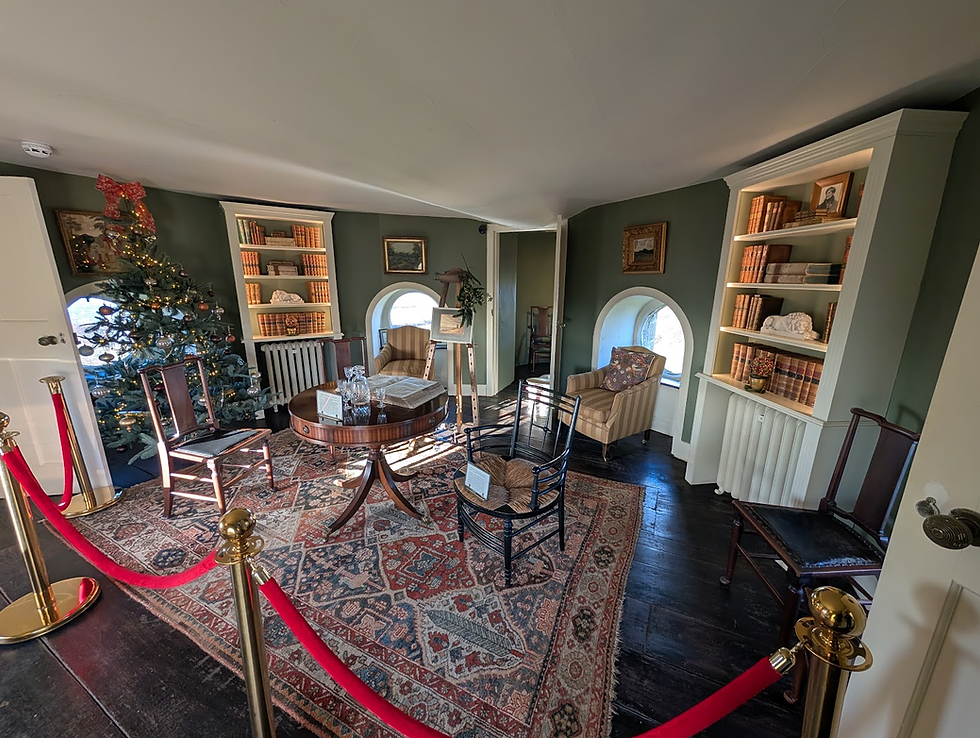
contains a chair made by William Morris, one of the regular visitors to the Tower.

As you can see from these photos, the windows on each floor are a somewhat different shape; the round ones in the study frame beautiful views of the surrounding countryside.

We climbed to the roof for more amazing views.


Between the cold and the wind, I didn't last too long at the top. It's hard to imagine, but the audio guide said that because there was no plumbing in the Tower, guests would often lug jugs of water to the roof and fill a metal tub for bathing - even in winter!
Driving home through the tunnels of trees

I was reminded of why the Cotswolds are officially classified as and Area of Outstanding Natural Beauty.


Comments