Art and the Artists
- chirp54
- Jan 30
- 4 min read
I'll be the first to admit that. although I love art. my education is lacking when it comes to English artists. Beyond the most widely known, ie. Turner, Constable, Millais, Gainsborough, et.al., I'm at a bit of a loss. How much I didn't know was revealed when I visited Leighton House. I was more than a bit embarrassed to learn that Frederic Leighton was not only a very popular Victorian sculptor, painter, and draughtsman, he was also president of the Royal Academy of Arts from 1878 to 1896. Additionally, he served on the boards of the British Museum, the National Portrait Gallery and the Sir John Soane’s Museum. He was the first painter ever given a peerage, but held it for only one day, as he died the day after it was given.
There are a number of his paintings in Leighton House, but it's the house itself that attracts visitors. There's a marvelous film, shown in the basement of the house, that serves as an introduction to Leighton's upbringing, his studies and travel, and his career. His success was practically guaranteed when Prince Albert convinced Queen Victoria to buy his painting, "Cimabue's Madonna is Carried in Procession Through the Streets of Florence," in 1854.
Leighton came from a rich family in Scarborough, Yorkshire, and his father continued to give him an allowance all his life. Having wanted for nothing, it comes as no surprise that he developed an idea of how a famous painter should live, and set about designing a house, with the help of George Aitchison, to fulfill that vision. It was remodeled and added to on several occasions, but when he died, his collection of art and artifacts was sold off by Christie's. The house was, by turns, a museum, a space for classes, a children's library and a theatre museum. In the 1980s Stephen Jones was appointed curator of Leighton House and began the process of restoring the interiors. The 2008-10 Closer to Home project continued this, redecorating the spaces based on historic accounts and photographs and returning items from Leighton’s original collection to the house. This included reguilding the dome in the Arab Hall, recreating the original flock wallpaper in the Dining Room and restoring the ziggurats on the roof of the Arab Hall.
The Entrance Hall, was the first room visitors encountered.

There's a large painting from the workshop of Domenico Tintoretto (1560-1635) on one of the muted brown walls, but the room only hints at the opulence inside.
The design of the Staircase Hall was inspired by courtyards found at the rear of Venetian palazzos of the 15th century.

The staircase provided an opportunity for Leighton to show off some of his collection of art and artifacts. The white urn and palm is a modern stand-in for the original bronze urn which would have stood here. They're hoping to hunt down the original, but in the meantime, this one adds quite a pop to the view.
Off the Staircase Hall, the Narcissus Hall is tiled in the most exquisite dark turquoise blue.

Leighton's office walls are covered in framed sketches and drawings.

The dining room, with its fabulous red walls and floor, is so dramatic, showcasing both Leighton's paintings and ceramic dishes he collected during his travels.

Michelangelo nursing his Dying Servant by Leighton (1862):

Mrs. Henry Evans Gordon by Leighton (1875):

The centerpiece of the house is the Arab Hall, in an extension built in the 1870s.

More expensive to build than the original house, the Arab Hall extension \ caused a sensation. Nothing like it existed in London and the profile and prestige of Leighton's home grew enormously as a result.


His only recorded comment on the Arab Hall was that he had built it "for the sake of having something beautiful to look at once in a while." Indeed. Most of the tiles came from Damascus, Syria, and date from the late 16th and early 17th centuries.
From the top of the staircase you can see the wonderful collection of paintings in the Staircase Hall.

Turning to the left you come to Leighton's bedroom. As extravagant as the rest of the house is, it's almost jarring how modest his bedroom is.
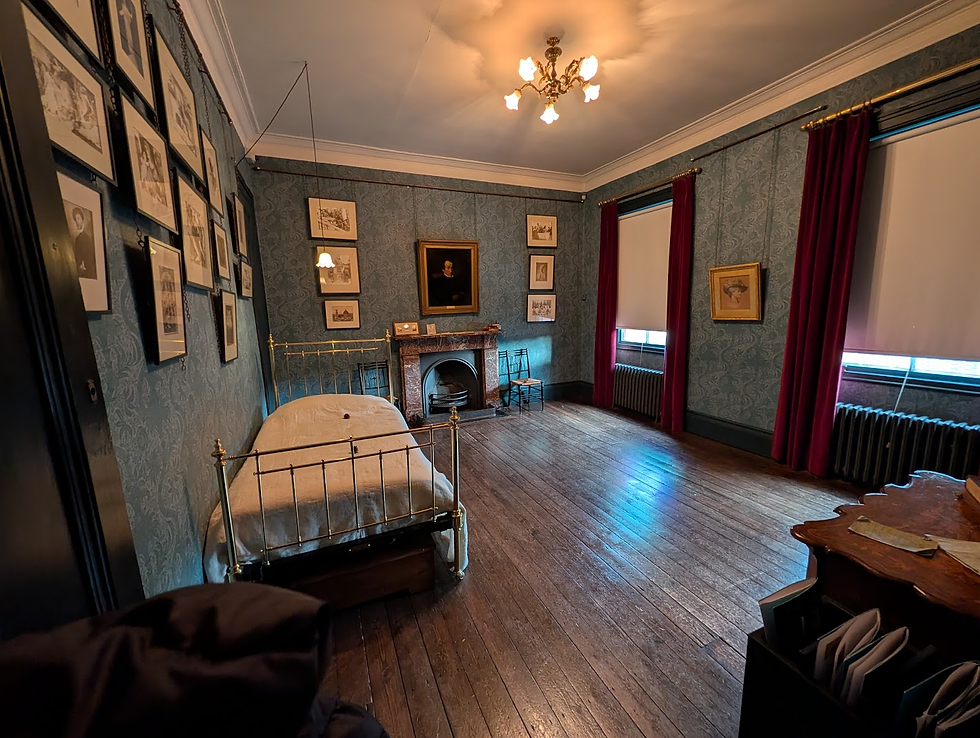
On one wall is a portrait by Leighton of his father, Dr. Fredrick Septimus Leighton.

Back to the landing, on the left is the Antechamber ,which he called his "snug." From the wooden screen in the back, you can look down into the Arab Hall.

Shortly before his death, he took out the south wall and added the Silk Room with its skylight and the most wonderful collection of paintings.

Euridice to Orpheus by Fredric Leighton:

Shelling Peas by John Everett Millais (1889):

Beyond that is the Studio, a vast space with amazing light.


That this amazing house filled with so many treasures sits nestled into the Holland Park neighborhood in a fairly plain brick structure makes it, somehow, even more appealing.


Comments