Carlisle Cathedral and St. Cuthbert Church
Leaving the Lake District we headed east to Carlisle, officially the only city in Cumbria. It was cold and windy so a stop in Carlisle Cathedral provided warmth, of both the physical and spiritual varieties.

The second smallest of England's ancient cathedrals, its exterior is unprepossessing though it did have its fair share of gargoyles.
Founded in 1122 as an Augustinian priory during the reign of Henry I, it became a cathedral in 1133. In 1233 the cathedral priory community was joined by two friaries in the city, one Dominican and one Franciscan. It was refurbished in the 13th and 14th centuries and again in the mid-19th century.
The cathedral was particularly busy when we visited because it was hosting the Museum of the Moon installation by Luke Jerram which seems to be following us around the UK.

We skirted the crowd and headed down the north aisle where we discovered some amazing medieval paintings. How they survived the Parliamentarians is a mystery because they usually whitewashed painted walls. The paintings are quite faded so there are illustrations below showing clearer images of them.


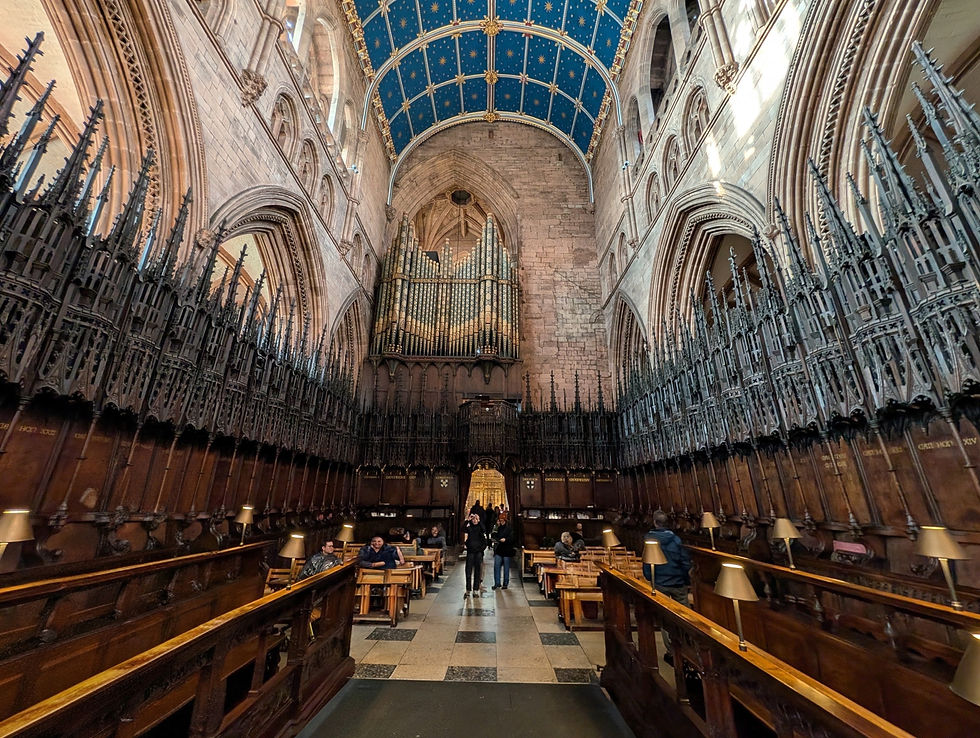
Back in the nave, the most striking detail of the church, to my mind, is the ceiling with its representation of the night sky.

In the south aisle, a series of posters address this ceiling and the use of celestial paintings in places of worship over time.
The ornately carved quire holds the organ with its painted pipes.

Leaving the quire and walking west you pass under a wooden canopy complete with coats of arms and ceiling bosses.

The most significant architectural feature in the cathedral is the east window. The wooden framework of the window is in the most complex of English gothic styles, Flowing Decorated Gothic. At 51 feet high and 26 feet wide, it is the largest and most complex such window in England.

At the west end of the Cathedral is the Treasury. It was created in the late 1980s and is located underground, per orders of the Carlisle local council. During its excavation, archeologists were called in because the ground was found to contain a Viking burial ground from the 9th century as well as Roman artifacts. Most cathedral treasuries I've visited contain the silver, and occasionally gold, items used in church ceremonies. This treasury also contained old ceiling bosses,

an alabaster sculpture,

a 15th century oak carving,

a 16th century cedar chest

and even a Tudor helmet.

Posters in the treasury told the history of the cathedral, century by century – really fascinating.
Just around the corner from the cathedral is the church of St. Cuthbert with St. Mary.

Though the current building was constructed in 1778, there have been churches on this site since the 8th century; the original church was likely detroyed during Viking raids. There is some evidence of use of this site as a Roman place of worship as far back as the 4th century. In 1644 when the Parliamentarians closed the cathedral, the mayor of Carlisle made St. Cuthbert's the Civic Church, a distinction it holds today.

Outside the church, the graveyard is the resting place of members of the Royalist garrison who died during the siege of 1644.
That evening we stayed at the Willowbeck Lodge.


The room and the dining experience were excellent and the little pond in front was charming. I definitely want to return.


Comments