Muncaster Castle and the Hawk and Owl Centre
After a few stormy days holed up in the house the weather cleared and we made our way to Muncaster Castle. Located on the property is the Hawk and Owl Center, which is where we headed upon arrival. We got there just as the 11:00 presentation was starting. We were seated in the back which was wonderful because, unbeknownst to us at the time, it was directly in front of one of the perches. There were three handlers there, one of whom served as the emcee. She told us everything we could want to know about the birds, their hunting styles and prey, their nesting habits, and where they are on the endangered list – most of them are listed. Here are some photos and videos of our favorite moments.
Tawny Owl

Southern White-faced Owl


The Snowy Owl


Eurasian Eagle Owl

We walked around the Hawk and Owl Centre a bit more then headed down to the Castle which, on this drizzly grey day, looked rather foreboding from the side view.

The entryway had quite a severe look, with its stone archways and animal skull.

The main hall was far more welcomng with its bright red walls.

When we checked in at the welcome desk we were told that a talk about the house was to begin shortly in the library so we headed there.

Michael, the gentleman you see behind the desk, is a resident historian at Muncaster Castle and he was not only well versed in its history, but was very entertaining in his presentation. Honestly, someone should give him a television show because he could give Lucy Worsley a run for her money.
There is evidence that there was a Roman settlement on this site, but the history of this castle and its owners begins in 1208 when the estate was given to Alain de Penetone by King John so that a tower could be built to help defend the local settlement of Ravenswood from the warring clans of Scotland. Michael told us that the settlements at the time were, a bit like the Old West in America, quite lawless. There were no armies to defend the settlements, so when a raid was expected, the lord would call for all men (basically anyone over 12) to come to the tower where they would be provided with armor and arms. There was, however, quite a sparse population around Ravenswood, so de Penetone had to improvise. Sentries around the countryside would light fires to alert the lord when the Scots were on their way. Local townspeople, seeing these fires, would bring their families and their livestock to the castle to prepare for a siege. With cattle, chickens and pigs close at hand, the castle could hold out against siege for a very long time. The castle had arrowslits, narrow windows through which arrows could be fired at the enemy. Hot sand, water, or – heaven forfend – sewage could also be poured down upon the enemy.
One of my favorite stories was that of Tom Skelton, a 17th-century jester hired by the Penningtons. (Over time the de Penetones became the Penningtons.) He is alleged to be the original “Tom Fool" (as in tomfoolery). Michael told us how, in those days, jesters were part clown, part satirist, and part advisor to their lords. Because they were “fools" they were allowed to talk freely without fear of punishment, unlike other members of royal courts or noble households. They could even make fun of something that their employer planned to do, thus causing the lord to entertain a differing point of view. Skelton was obviously a valued member of the Pennington household because his portrait still hangs at the castle.

Another story recounts how, after the Battle of Hexham in 1464, Henry VI fled to Muncaster Castle where Sir John Pennington sheltered him. Henry gave Sir John a Venetian glass drinking bowl, with a wish: "As long as this bowl remains unriven, Penningtons from Muncaster never shall be driven". The glass, which is still intact and still at the castle, is known as "The Luck of Muncaster." Because there is quite a bit of superstition surrounding the bowl, it is hidden away by the current owners, Peter and Iona Frost-Pennington. Michael said that even as castle historian he has never seen it.
The audio guide to the castle is very good and because it was recorded by members of the family, it includes some interesting bits I wouldn’t have expected. In the fifth Lord Pennington's will, he specified three things: Muncaster Castle and its estate were to be inherited by his first cousin, Sir John Ramsden, Iona's grandfather, “The Luck of Muncaster" must never leave the Castle, and whoever lives at Muncaster must bear the name Pennington. That's why Peter Frost, the current occupant and husband of Iona Pennington, is now Peter Frost-Pennington. I'd change my name, too, if I had the chance to live here.
The symbol of the Pennington family is the “cat o' mountain" or wild cat. They're known for being ferocious. Funny, then, that this little wooden cat is meant to represent them.

The Grand Dining Room is exquisite. What looks like wallpaper is actually gilded embossed leather and is, apparently, incredibly difficult to maintain.


The table in the center was made with wood from one tree.

The drawing room is beautiful with its barrel vaulted Italian plaster ceiling.

Iona Pennington's audio noted that in the Victorian era, "ladies would withdraw to this room after dinner to have tea and gossip while the men stayed in the dining room, smoked their cigars, and gossiped." Because our visit was so close to Halloween, the room's occupants were some silly skeletons.
On the second floor was The King's Room, so called because it is believed that this is the room in which Henry VI stayed when he sought shelter here in 1646. Another King, Edward VIII stayed here during the 1930s. The four poster bed is magnificent and on the headboard you can see pictures of both of the above-mentioned monarchs.


It's in this room that you can find "witch marks" lightly carved into some of the wall panels.

This is the Bishop's bedroom, though no one can recall which bishop stayed here. It is now where visiting family members stay, but I assume they move the furniture around a bit when that occurs.
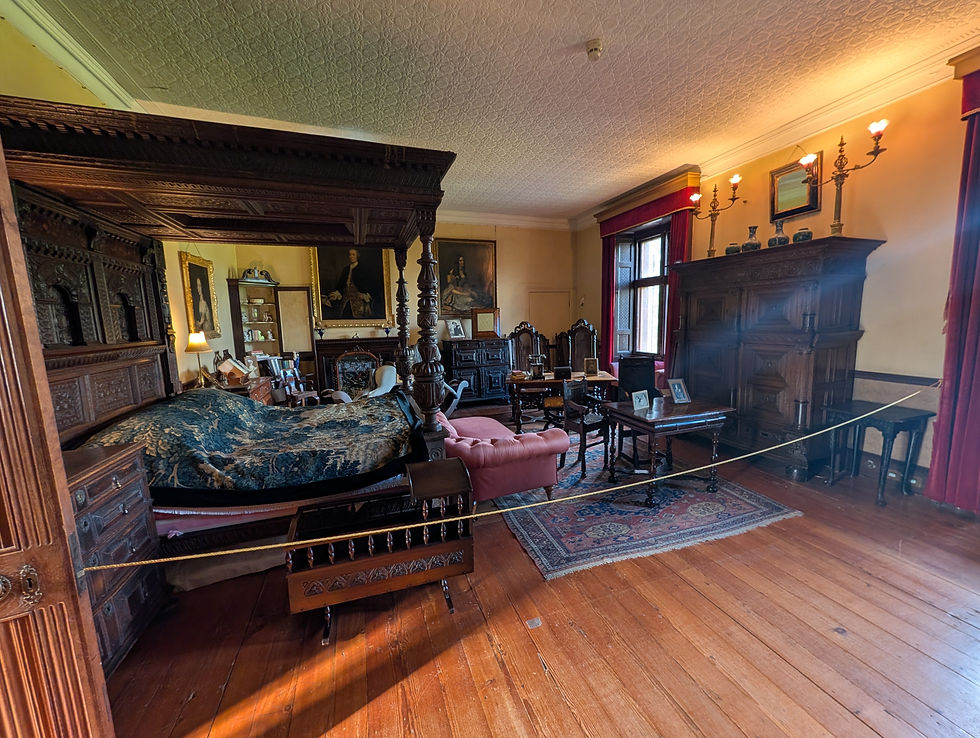
Also on this floor is the brightly painted Tapestry Room.

It is reportedly haunted by the ghost of Margaret Pennington, the only child of the 4th Lord Muncaster. She died of “screaming fits" and guests who have stayed in the room report hearing a child crying and occasionally even a nurse singing the child to sleep. For that reason the Penningtons don't put guests in this room unless they request a “ghost sit" so they can experience the phenomena themselves. The fireplace comes from Longley Old Hall in Huddersfield and dates from the 16th century.

The Queen's room is currently set up as a salon, not a bedroom, and being roped off by the door it's hard to get a good look at it or its carved fireplace. .

The Queen's dressing room is next door and contains another wonderful four poster bed as well as a rattan “throne" which hides a small chamber pot.

The hall leading to the stairs contains a lovely stained glass window and a magnificent 17th century Jacobean wall hanging.
By the time we left the house the sun was shining and we were able to enjoy a view of both the front of the castle and the view over the Cumbrian countryside.


Walking back to the parking lot we passed an old barn, one side of which had been adapted to help the bees and insects. Loved the name: Bugingham Palace.

There were a couple of zombies hanging around
and under a tree a small statue of a dog which wasn't there as a Halloween decoration, so I wondered if this was a memorial to a beloved pet of the Pennington family.

Someone had carved a giant stump into a throne

and there was a huge wooden archer complete with bow and arrow.

We stopped for lunch at a pub down the road. I assume the name is a reference to The Wind in the Willows, not a judgement on the pub itself.

On the way back home we stopped in Whitehaven, a seaside town famous for its Georgian architecture and its importance as a port for coal.

It has, sadly, seen better days and once again Bruce found himself somewhat unwelcome at the old pub he went to check out. I found an interesting little park where the seaside meets the high street.

The pavement is inlaid with pebbles and stones and engraved with this verse:
Whitehaven Green Market
Where once seafaring men were hired and tall tales told
Where skills in splicing rope carried more weight than facial scars
Or a full compliment of fingers
Here in days of old voyage deals were struck
Over a firm handshake and a piece of bitten gold
Pigtails and rum-soaked buckled shoes
Brought home the recent foreign news
And memories of this small piece of ground
It was very cold by the water so I didn't take a lot of time to walk around town. The few streets I did venture down contained mostly bars, vape stores and charity shops. Not a place I'd probaby choose to visit again. The harbor was lovely, though.

As we approached our digs, we passed the local girls enjoying their dinner.

Another lovely day in Cumbria.


Comments