Wright of Derby
- chirp54
- Apr 28
- 3 min read
The National Gallery is a magical place and they always have wonderful special exhibitions. On this visit, the subject of the special exhibition was Wright of Darby: From the Shadows.

Of Joseph Wright, Wikipedia says,
"Wright is notable for his use of tenebrism. an exaggerated form of the better known chiaroscuro effect, which emphasizes the contrast of light and dark, and for his paintings of candle-lit subjects. His paintings of the birth of science out of alchemy, often based on the meetings of the Lunar Society of Birmingham, a group of scientists and industrialists living in the English Midlands, are a significant record of the struggle of science against religious values in the period known as the Age of Enlightenment."
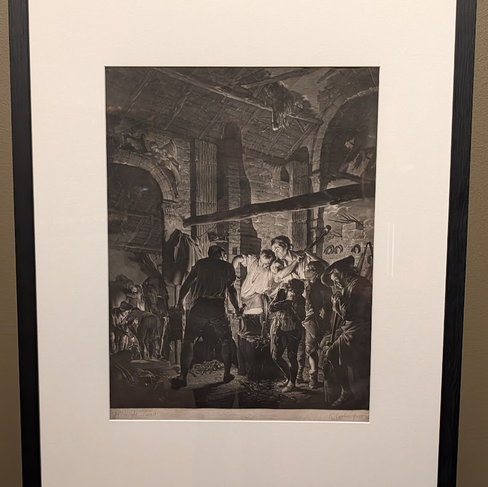
Wright's candle-lit paintings are the subject of this exhibition and they are magnificent. He was not the first to use the technique of tenebrism; he was influenced by earlier practitioners of the technique, especially Caravaggio. I was amused to read that Wright often made mezzotints, black and white prints of his paintings, because he could mass produce them and, thus, make more money. Even then, commerce was king.



Wright was born in Derby and at 17 went to London to study with Thomas Hudson, the master of Joshua Reynolds. He returned to Derby, lived for a time in Liverpool, went to Italy for a while to paint, moved to Bath, then returned to Derby where he spent the rest of his life. He had health issues and was treated by his friend, the noted doctor Erasmus Darwin (grandfather of Charles Darwin) who brought him into the orbit of the Lunar Society. They were a group of individuals who were interested in various scientific subjects. One of Wright's most famous paintings, The Air Pump, was most likely influenced by his association with them. It shows an experiment with a bird in a glass jar and the effects on the bird as the air is pumped out of the jar. Pretty cruel, but it was meant to show that it was air that kept the bird alive, not the will of god. Note how distress causes the woman on the right to turn away. This painting, by the way, is enormous - probably eight feet wide.

Another painting influenced by the Lunar Society was A Philosopher Lecturing on the Orrery, a mechanical clockwork model of the solar system.

Present next to the painting was an actual orrery.

Another of his painting (also shown above in mezzotint form) was Three Persons Viewing the Gladiator by Candlelight. Three artists study a sculpture of The Borghese Gladiator, sculptor unknown. The sculpture was also on display.


I liked the way it was lit, giving the same impression as the painting.
A Blacksmith's Shop mostly focuses around the action at the forge. I was entranced by the face to the right that has such character.


A Philosopher by Lamplight (1769):

The figures in the painting, particularly the philosopher, draw all the focus. I hardly noticed the skeleton that the philosopher was studying.
Perhaps my favorite of these paintings was a bit less dramatic and doesn't really come across very well in this photo. It was An Earthstopper on the Banks of the Derwent (1773).

The brushwork was wonderful. All the grasses and the water just came alive.
Also in the exhibition was a sign which directed viewers to some of the other galleries where you could see the work of artists who influenced Wright.
The Concert by Hendrick ter Brugghen (1627):

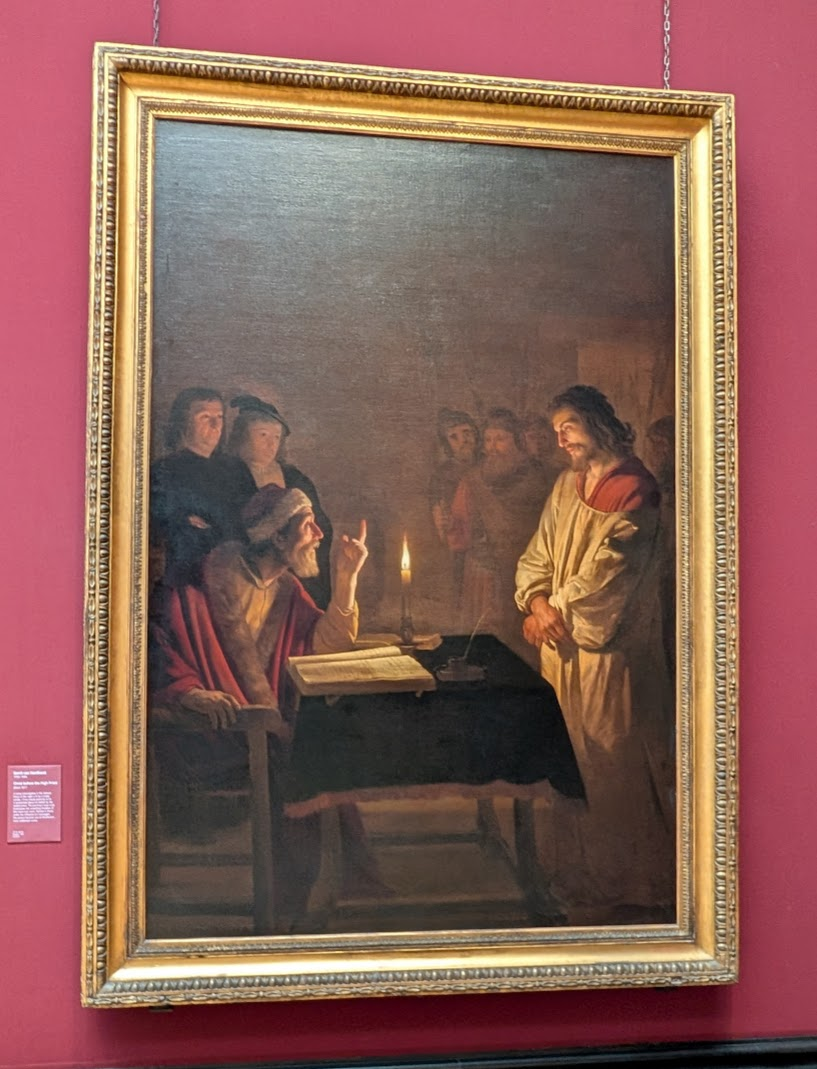
Christ before the High Priest by Gerrit van Honthorn (about 1617):
In one of the other galleries I found another painting by Wright, not in his signature tenebrism style. To me, it seemed utterly conventional and boring by comparison.

Such a wonderful exhibition at one of my favorite London museums.


Comments