A trip to the moon
- chirp54
- Nov 26, 2025
- 3 min read
One chilly, overcast day we hopped on the bus to Tewkesbury for a visit to Tewkesbury Abbey. Much to our surprise, we were there on the last day of a special exhibit, "Museum of the Moon." A giant replica of the moon was suspended from the ceiling of the abbey.

It's an art installation by Luke Jerram who wanted to
"transform the Abbey into a space of wonder, reflection and imagination. Measuring
seven meters in diameter and featuring detailed NASA imagery, the internally lit moon
sculpture floats amidst the gothic arches, accompanied by a tranquil soundscape
composed by Dan Jones."
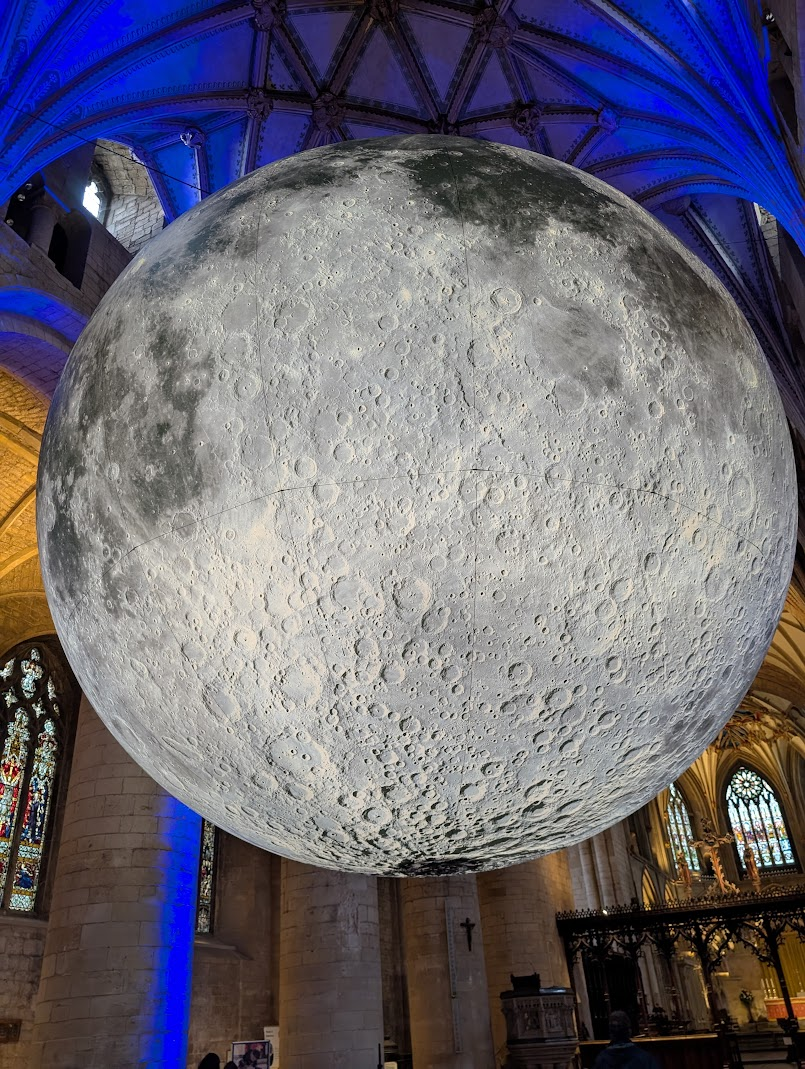
The installation has been touring the world since 2016 and is traveling all over the UK this year, mostly to churches, abbeys and cathedrals. The soundtrack includes snippets of JFK's pledge to get a man to the moon and dialogue of the Apollo astronauts as they landed on the moon's surface. It wasn't at all what I expected to find, mind you, but it was certainly interesting.
A former Benedictine monastery, Tewkesbury Abbey is considered one of the finest examples of Norman architecture in Britain.

work on it was started in 1087 with the building being consecrated in 1121. In the 1400s the wooden ceiling was replaced by lierne, or stellar, vaulting. Instead of connecting to a central boss, the ribs connect to one another and transfer the load outward and downward, which allows for larger windows, giving more light.

The places where the ribs meet, known as bosses, have decorative carvings. There's a boss on display - not sure if it's an original or a replica - of an angel playing bagpipes.

The font is a bit of a mashup; the base is from the 13th century, the bowl is Victorian.

The ceiling at the eastern end of the abbey is magnificent.

Tewkesbury Abbey has played a significant role in English history. The sun, a symbol of the house of York, can be seen in the ceiling above the quire.

It was put there as a memorial to the York victory over the house of Lancaster in the Battle of Tewkesbury. The Yorkists were not the nicest of fellows. In fact, when some of the defeated Lancastrians were in the abbey seeking refuge, the Yorkists scandalously stormed the abbey and killed them, preventing them from re-forming and challenging the Yorkists for the monarchy again.
At Henry VIII's dissolution of the monasteries, the people of Tewkesbury managed to convince the crown that the abbey was their parish church and were allowed to purchase it from the Crown for the value of its bells and lead roof, which would have been salvaged and melted down. Perhaps that's why there is a chapel dedicated to St. Dunstan, patron saint of bellringers.

There are a number of notables buried in the Abbey. Amongst them are George, Duke of Clarence. Accused (not unreasonably) of treason by his brother, King Edward IV, he was imprisoned in the Tower of London and found guilty. He was allowed to choose his method of execution and chose to be drowned in a butt of Malmsey wine, or at least that's how the story goes. Though he was buried in Tewkesbury Abbey, George doesn't have a fancy tomb. He is, in fact, buried under the floor of the abbey, under this grate:

A rather more impressive tomb is that of Hugh, Baron le Despenser, and his wife Elizabeth. They were involved in the founding of the abbey.

On the other side of the tomb, on the top of it, is an effigy of Baron le Despencer, guarding his tomb.

The Warwick or Beauchamp Chantry:

The Denny Windows, designed and made by Tom Denny in 2002, mark the 900th anniversary of the Bendictines coming to Tewkesbury.

After a last look at the moon

we exited the Abbey and saw that all are welcome, regardless of species.


Comments