Ashburton and Tavistock
Ashburton is one of my favorite stops when in the South Hams. It's chock full of antique stores and little shops.

There's a fish deli where I stock up on delicious treats like salmon mousse with dill and pickled fish. Okay, maybe not everyone's choice of fare, but for me it's heaven. After a wander about, I met Bruce at the Old Exeter Inn, formerly the Exeter Inn, one of the oldest pubs in the UK, dating to 1130.


It was here that Sir Walter Raleigh was arrested for high treason for his part in the plot against King James I. The pub owners even provide a souvenir scroll to all visitors recounting Raleigh's fate. There are several small rooms, and they're all quite inviting.


These days the pub is known not for political intrigue, but for its wonderful meat pies. You'd need a hearty appetite to finish one of them since they come with veg, potatoes, Yorkshire pudding and crackling. Their fame is justifiable, because they are delicious.

Happily, you can box up the remainers and take them home to enjoy another time.
One place we hadn't visited during any of our previous stays in Devon was Tavistock. It's quite a long drive from where we were staying and there's lots of road work being done, but it was well worth the trip.

Tavistock is famous for so many things. It was inhabited long before historical records. The Abbey of St. Mary and St. Rumon was founded in 961 by the Earl of Devon. After its destruction by Viking raiders in 997 it was rebuilt. This is where the first bit of Tavistock trivia comes in. Devon cream tea, which is now internationally famous, was said to have originated when the monks of the abbey served bread with “clowted" cream to the local workers who helped with its rebuilding. Of course, tea didn't arrive in England for some 600 years, but that's splitting hairs, isn't it? In 1105 Henry I granted the monks permission to hold a pannier market, which still takes place today. By 1305 tin mining was so important here that King Edward I appointed Tavistock a stannery town (a historic administrative center designated to manage the tin industry.)
It's about the tin industry that the Tavistock Museum, located in the Guildhall,

devotes an enormous amount of space and it's no wonder, because the Cornwall and West Devon mining landscape has been named a UNESCO world heritage site.
At the entrance to the museum is a wonderful mixed media sculpture called The Alchemy of Copper which features disused mining equipment and coins lodged in the wood.

Tin was mined in the area in the medieval era as early as the 12th century. By the 17th century, tin mining was on the wane and the textile industry gained importance. By 1800 the textile industry was headed the way of tin, and copper mining took over as the area's biggest industry. When the price of copper began to fall, the mines diversified and started mining arsenic. We all know arsenic as a poison, but it was also used as an insecticide and as a dye, producing a vivid green color. Fabric dyed this color was highly sought after and was used to make dresses, gloves, and even children's toys, to disastrous effect.

Tavistock's history is explored in the museum, including the life of its famous son, Sir Francis Drake and its importance as a river port.

Part of the Guildhall building has also served as a court and jail.

Its proximity to the Tavy River meant that the cells often flooded

On the main floor, the courtroom comes complete with props and little hand-held signs telling the story of a particular crime and its resulting trial. I'll bet kids love coming in to the court and exploring it.

Upstairs in what was the Robing Room, there is a temporary exhibition of art called Ruins and Monuments, celebrating the 20th anniversary of the region's UNESCO World Heritage status.

There were paintings, photography, and a wonderful video presentation. Though this photo doesn't show it very well, it was really an excellent exhibition.
From the Guildhall I wandered next door to the Pannier Market.


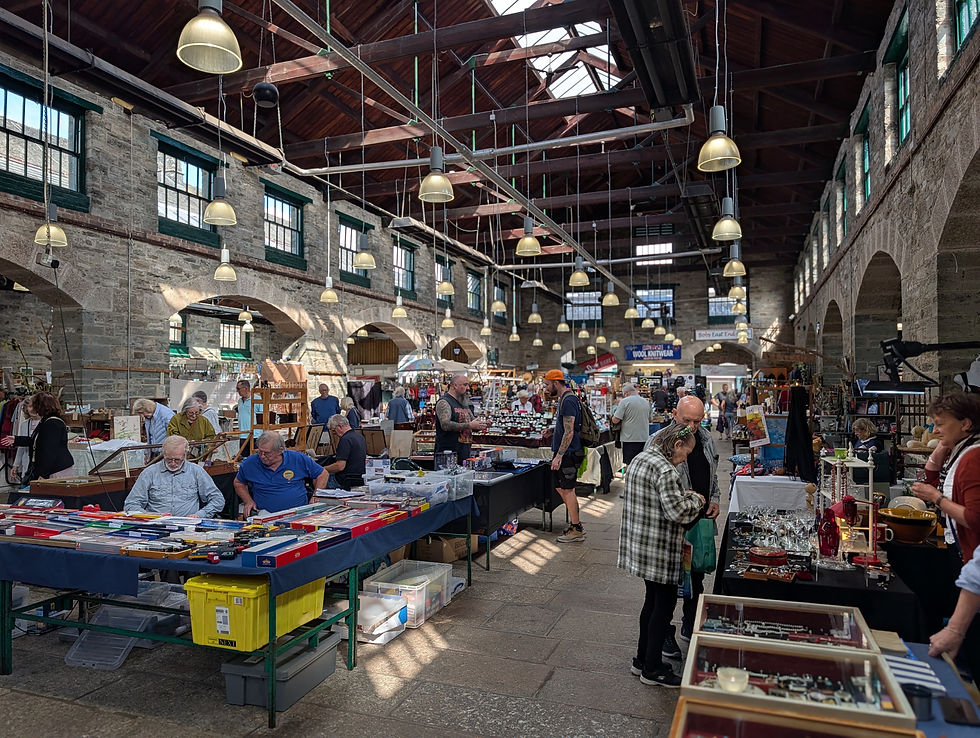
According to the visitor's center, they have different market themes for different market days. The day I visited the theme was "antiques and collectibles." I suspect that the stalls around the edge of the market remain all the time and just the tables in the main hall change. Outside the main market building there are shops and restaurants - I had a delicious crab and avocado salad at Molly's Kitchen.

In much of the area around the Pannier Market there are massive stone buildings

which fit well with the Guildhall and St. Eustachius Church.

To get back to the carpark, We walked along the River Tavy for which the town was named.


It's an interesting town and one I would like to explore further.


Comments