Barnstaple Treasures
- chirp54
- Dec 14, 2025
- 3 min read
The closest town to our digs in North Devon was Barnstaple, so we hopped on the bus for a look around. As Bruce headed out to find old pubs, my first stop was the Barnstaple Museum. The ground floor is devoted to the life of the town over the years, from the prehistoric animals which roamed the area

to the town's industries


and the North Devon Yeomanry's participation in the wars.

It was the sort of thing one often finds in small town museums. I was surprised to learn, however, that Barnstaple was the home of two factories that turned out breathtakingly beautiful goods: North Devon Art Pottery by C.H. Brannam & Sons and Shapland & Petter Furniture.
One room was jam-packed with examples of the decorated pottery.


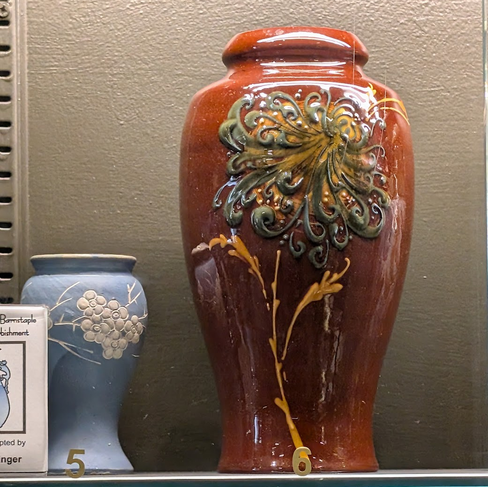


Brannam and sons started in 1848 and was a huge employer in the area until it went out of business in 2005. It faced changing consumer tastes, increased competition and management challenges, issues which they were unable to overcome. It made me sad to think that cheap imports of dubious quality could spell the end for a company that did such splendid work.
Around the corner on the first floor was a room of furniture by Shapland & Petter. The business was established in the late 19th century and made furniture in the Gothic Revival and Sheridan Revival styles but it was the Arts and Crafts style for which they became well known. The pieces seemed to me to have an Art Nouveau look. In fact, the pieces on display in the museum reminded me a bit of Charles Rennie Macintosh furniture with its use of floral motifs and inlay.


Shapland and Petter employed craftsmen but also used the most up-to-date machinery available for their products, making their furniture affordable for the middle class. During WWI, the firm produced shell cases, ammunition boxes and airplane propellers in addition to their normal furniture production. As demand for Arts and Crafts waned, they switched their focus to office furniture. At one point they were one of the largest employers in town, but like Brannam & Sons, cheap imports ultimately drove them out of business. Their factory, with it's broken windows and crumbling facade stands as a poignant reminder of an era when Shapland & Petter, and the city of Barnstaple, knew more prosperous times.

In front of the museum is the Albert Clock Tower which was built in 1862, the year after Prince Albert, consort to Queen Victoria, died of typhoid fever.

Venturing into town I discovered that Barnstaple has a long high street with an inordinate number of expensive jewelry stores. I'm at a loss to explain why because it is clearly not a prosperous town. Most of the stores on the high street were discount places and charity shops, with some lower end fashion stores here and there. There is a pannier market in town, which is a form of indoor market especially popular in Devon and the West Country. Pannier markets take their name from the panniers, or baskets, that were once used to bring produce to town on the backs of pack animals.

Barnstaple's pannier market didn't have much in the way of fruits and vegetables. It was mostly a collection of craft tables and cheap clothes, with a couple of food stands and picnic tables thrown in for good measure. The market itself is quite striking and I can just imagine how lively it must have been in its heyday.
Down by the River Taw is Queen Anne's Walk, formerly the Mercantile Exchange. It currently houses a small cafe

In the little plaza in front of it, the history of Barnstaple is laid out in a series of mosaics.





On the way back to the bus stop, I walked along the River Taw which was swelled and flowing strongly thanks to the abundance of rain the week prior. Those grey skies told me that we hadn't seen the last of the rain. At least I made it home before the skies opened.


Comments