Bristol Cathedral
- chirp54
- Dec 10, 2025
- 4 min read
When I was much younger and working on the Ocean Princess cruise ship, the cruise staff would accompany the guests on the shore excursions. Sometimes we went on exciting journeys, down an Amazon tributary, say, or into the hills of Norway for a train journey around the fjords. Most of the time, though, we escorted the city tour which had acquired the nickname "The ABC tour". The ABC stood for Another Bloody Cathedral. Now that I'm about the same age as the passengers we carried then, I can appreciate the beauty and history of these places. Today's "ABC" was Bristol Cathedral.

Upon entering there is a sign that says that tours are available. I inquired and the man at the desk asked when I wanted to start the tour. I said, "Now? Well, anytime that's available, actually." He said, "Fine. Let's start now." I am hugely embarrassed to say that I don't recall the name of this gentleman (John?) because he gave me the most amazing tour. We started outside the Cathedral where he explained what the city of Bristol would have looked like in the 1100s when building began. Bristol Cathedral was founded as St Augustine's Abbey in 1140. The original abbey church, of which only fragments remain, was constructed between 1140 and 1148. We walked across the churchyard to the Abbey Gatehouse, built in 1148 and still in use, though now it houses the diocesan offices.

It's astounding that the very detailed carving on the walls still remains.

We then walked around to the side of the cathedral where the cloisters once stood.
Only one of the ambulatories of the cloister remains.

In it, there are modern stained glass windows. This is because of the Bristol Blitz of World War II. Because Bristol was important due to the presence of Bristol Harbor and the Bristol Aeroplane Company, the German Luftwaffe bombed the city heavily. It was, in fact, the fifth-most heavily bombed British city of the war. The interesting thing about the new windows is that they're made in a sort of patchwork style out of fragments of the old windows which were salvaged.


Off the cloister is the Chapter House.


It was designed in a sort of Ottoman style. There are no crosses or references to Christianity in the room. In fact, the columns over the door are carved in a style often used in mosques. Some columns are carved curving left, some right, but in the center is a column whose carving changes from right to left and back again. Traditionally this is done to highlight its imperfection, because only God is perfect. The lack of Christian symbolism indicates that this was a space that was meant to be used by people of all faiths.


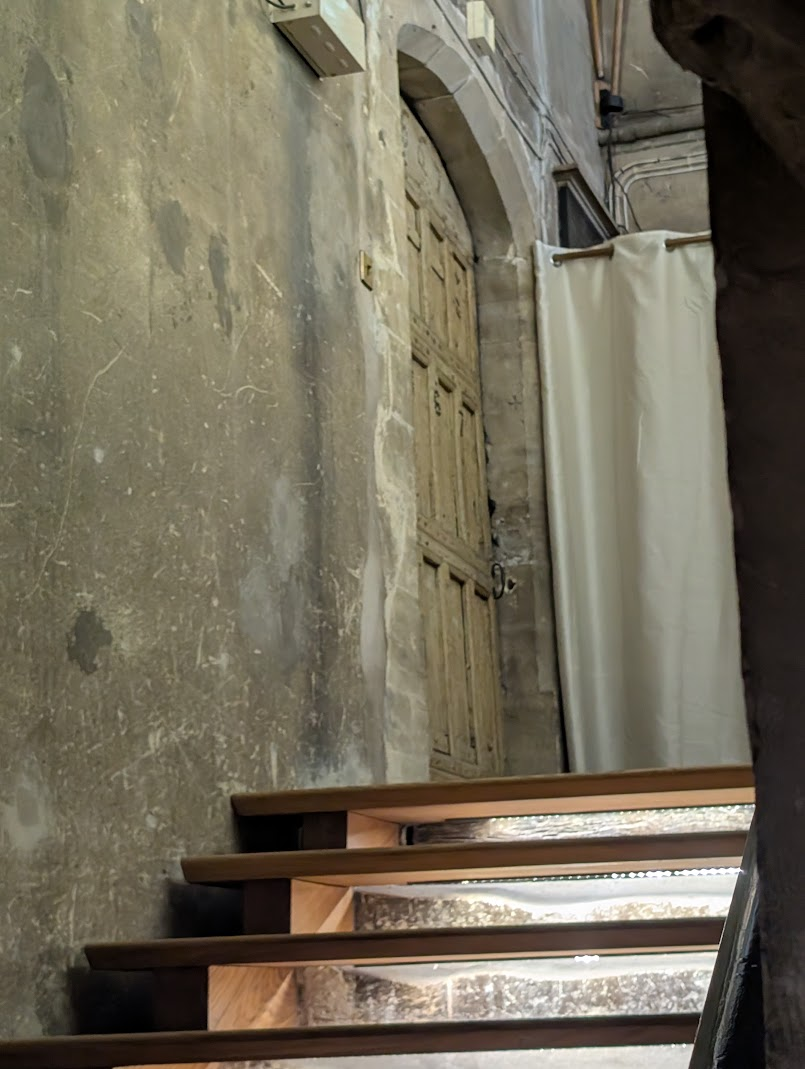
We entered the cathedral from the Cloisters and passed a set of stairs that would have led from the canons' dormitories into the cathedral. The door at the top of the stairs dates to around 1160. You can see the original stone steps worn down by the tread of the canons.
At the bottom of the stairs and mounted on the wall is the carving "The Harrowing of Hell." It depicts Christ descending into hell, standing on the head of Satan, rescuing Adam and Eve from imprisonment. This carving was found when excavation was being done in the Chapter House. It was found carved side down. Scholars think that this happened during the Reformation when many relics were destroyed. The carving would have been seen as idolatry, so it was buried upside down so that only a plain slab of stone would show, should anyone dig in that area.

The Berkeley Chapel, named after Robert Fitzharding, Baron of Berkeley, who founded the Abbey, is often used for the daily eucharist.

We then entered the Eastern Lady Chapel built between 1298 and 1330.

It would have been used as the alter before the high alter was added in the 19th century. the richly painted screen was repainted in 1935, but looks similar to how the original abbey would have been decorated.

William Bradshaw was Bishop of Bristol in the early 18th century. He was said to have had an enormous ego and that would seem to be the case. When you look closely at the screen, you can see that his initials feature prominently.

The Elder Lady Chapel was next, built around 1220.

It is the oldest surviving part of the cathedral. The stonework of its ceiling has been left exposed. Do you see the pillars on the left in front of the stained glass windows and in the alcoves on the opposite walls? They are blue stone and serve only as decoration, not to bear weight.


Walking out of the Elder Lady Chapel, we turned left and find ourselves at the quire and high alter.


We turned around and walked east into the newest part of the Cathedral. the Nave. The Cathedral was being expanded in the 16th century, but all work halted when Henry VIII disbanded the monasteries. The land around the Cathedral was used by locals for housing. In fact, where the nave now stands there were three houses and a brothel! In the 1860s those were cleared and work to finish the nave was started, built using plans and stone from around 1330. It's such a majestic space.

Remember those blue stone pillars in the Elder Lady Chapel? They are echoed here in the design of the supporting columns.

I mentioned the Bristol Blitz earlier. In memory of it, one of the stained glass windows shows the flames and destruction caused.

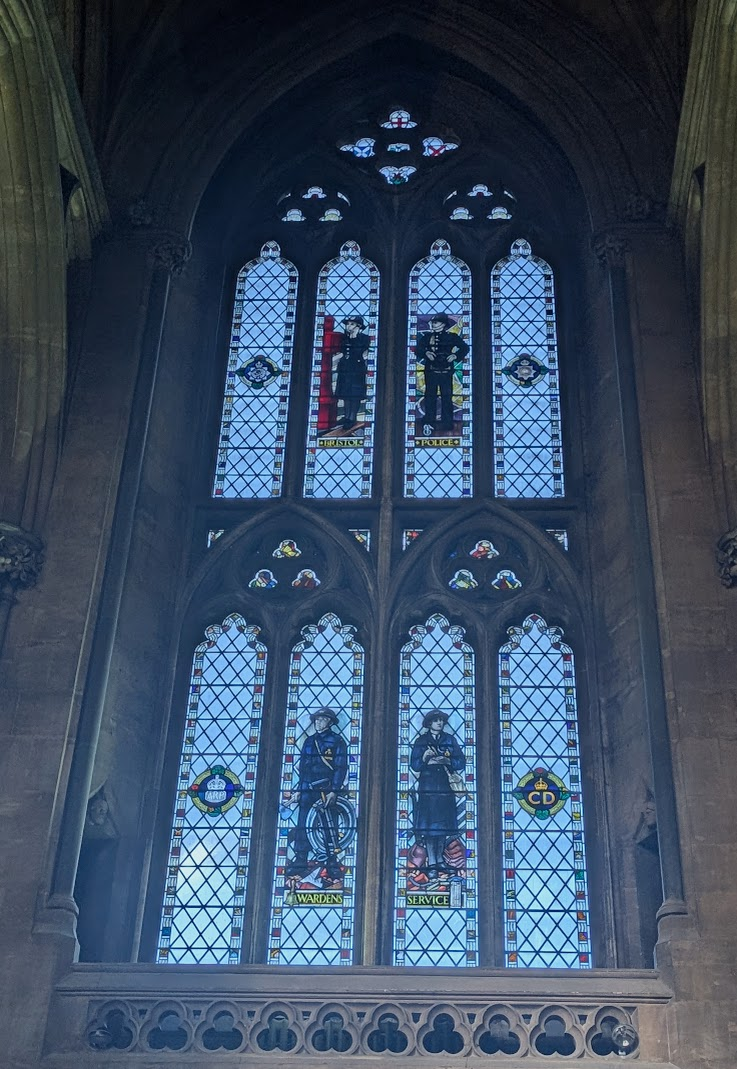
Other stained glass windows in the nave feature all the heroes of WWII. Not just soldiers, but all the heroes.
The Fire Services and the British Red Cross:

The Bristol Police and the Warden Service:
Women's Services and the Home Guard:

Nursing Services and St. John Ambulances:

Our last stop was at the Western door where there is a display that talks about slavery and examines Bristol's role in the slave trade and the wealth the city derived on the back of the enslaved.

Poor John gave me such a wonderful tour that it ended up taking up some of his lunch break. It was a fascinating 90 minutes and I felt so lucky to have had the benefit of his passion and knowledge,


Comments