Dartmouth and Ashburton
- chirp54
- Feb 11
- 3 min read
I've visited Dartmouth before and have written about it as well. (see posts from October, 2024 and June 2025) I keep going back, though, because it's such a pretty town. I'm particularly taken with its beautiful old buildings.

I love how the shop on the corner leans so far over the road. It looks like it's about to dive into the water with the little boats.
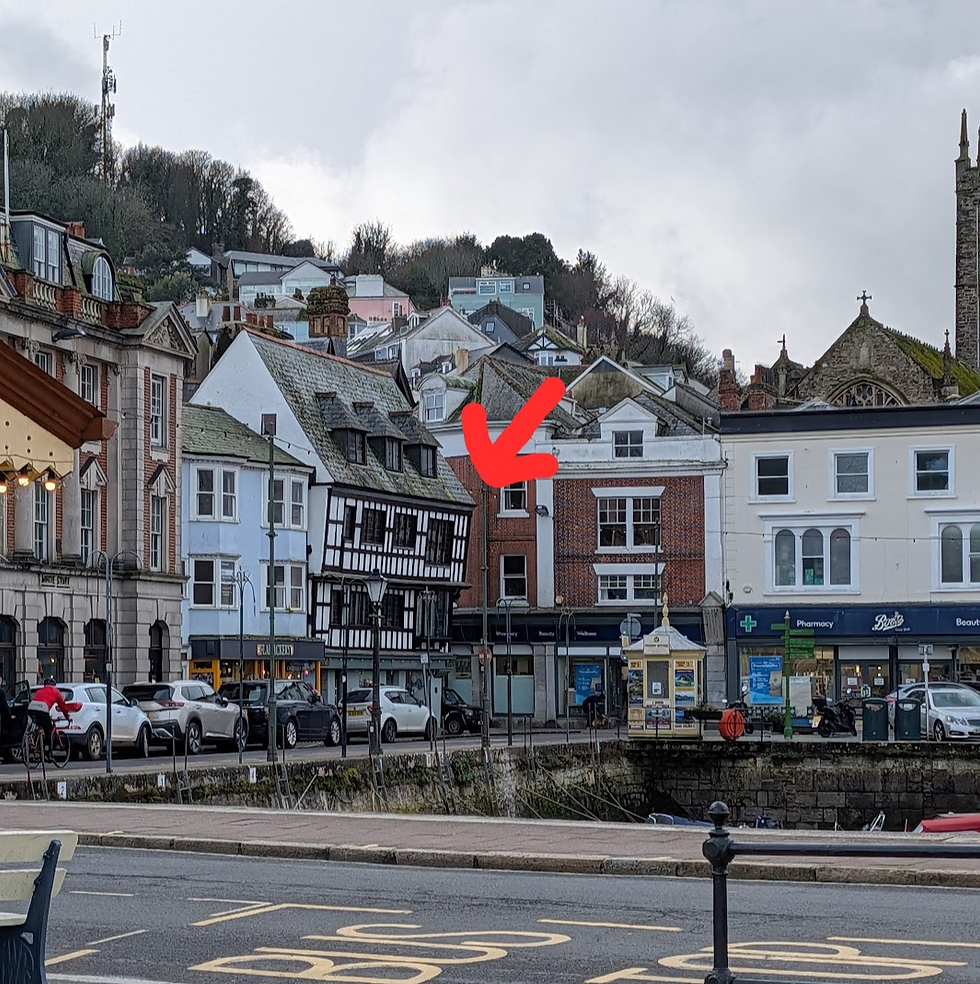
A pub called The Cherub occupies the oldest building in town, circa 1380.

Its original use is thought to have been as a merchant's house. It has overhanging floors, known as jetties, which were built to maximize upper-level floor space in cramped, taxed, or high-density towns without encroaching on street-level rights-of-way. Though it's in the oldest building, it's not the oldest pub; it only became a pub and restaurant in the 1970s. You can read about the oldest pub, The Seven Stars, on Bruce's pub blog.
Near the seafront stands another one of my favorite buildings, York House, a Grade II listed building built in the Elizabethan style during the Victorian period - gotta get as many royal connections as possible.

Probably my favorite place to find clever cards, prints, coasters, etc., is Simon Drew Gallery. Every time I visit he's got new designs that always make me smile, like this one:

I had the pleasure of meeting Simon last time I visited. He is as stylish as his cards. If you visit Dartmouth do check out his shop. If you can't make it there in person, check out his online store.

One last stop in Dartmouth was the George and Dragon bar, cafe and restaurant. These people understand marketing!

It seems that every time we come to South Devon we tend to go to the same little towns. A few of the places we like to visit were heavily impacted by three major storms that hit the area in quick succession. In fact, the road to Torcross was completely destroyed in the last storm. We decided, then, to visit the town of Ashburton and I'm so glad we did.

Ashburton is an ancient stannery town, stannery meaning an administrative district for tin mining in Cornwall and Devon, and it dates to Saxon times. The high street is filled with galleries, book shops, eateries and antique shops. There is a pub in town, the Old Exeter, which has been in constant use as an inn since 1130. Sadly, it's closed for refurbishment at the moment so we couldn't visit. There were several shops that sorely tested my willpower. A sterling silver tea strainer and a gorgeous cobalt and silver vase tempted me in a shop called In a Nutshell. A Victorian garnet ring kept calling, "Buy me, buy me!" in the Reuben Lenkeiwicz Art Gallery, and I found three little chandeliers with my name on them in The Shambles, a wonderful shop run by a delightful woman named Pip. We got talking politics and I could have stayed there all day. So sympatico!
At the end of the street is Salty's Studio with their quirky, clever designs. After seeing this tea towel, I'll never think of Cornwall and Devon in the same way again.

My favorite item, though, was this pencil.

Up the hill from the commercial area is St. Andrew's Church.

There has been a church on this site since 820AD. The current building is approximately 580 years old. It's quite a large church for such a small town, reflecting the wealth from former local wool and tin industries.
The main building was constructed between 1405 and 1449 in the "Perpendicular Gothic" style, but most of the interior is the result of renovations from the 19th century.

There is a typical Devon Wagon Roof - the original was installed in the 15th century, the current roof was heavily restored in 1883.

The four wonderful stained glass windows date from 1877 to 1895.
In the sanctuary is the high alter with its reredos (a three part carving) showing the Annunciation, the Nativity, and the Crucifixion. The reredos is the work of Herbert Read of Exeter, as is the screen separating the nave and sanctuary.


Above the reredos, the east window features a depiction of the last supper. The church brochure explains that there are only eleven disciples pictured; Judas has already left.

The roof of the Lady Chapel contains wonderful carved, painted ceiling bosses.

Walking back along the North Aisle you come to the Chapel of Thomas à Becket, containing war memorial plaques to the dead of the two world wars. It is now used as a children's area. I love the modern looking stained glass window in this chapel. It shows the martyrdom of St. Blaise, patron saint of woolworkers.

Our visit to Ashburton turned out to be a wonderful day trip and I will definitely return.


Comments