Dublin, Ireland and Christ Church Cathedral.
- chirp54
- 2 days ago
- 5 min read
It's hard to believe that as much time as we've spent in the UK, we've never ventured to Ireland. So many people have told me how wonderful it is, how green, how welcoming, so we decided to start this trip with a visit to the Emerald Isle. We flew Virgin Atlantic to London, then transferred to a British Airways flight to Dublin, which will be our home for the next week. Getting from Dublin airport to our flat near the Kilmainham gaol was the worst part of the trip. It took over two hours to make what is normally a 25 minute trip thanks to rush hour traffic. By the time I unpacked and collapsed into bed I'd been up for around 31 hours. Needless to say, I slept well.
After breakfast at home, we made the short walk to the bus stop. Just outside our flat is a very interesting statue. I'll have to go investigate it later.

We hopped the 13 bus into town and headed for the Christ Church Cathedral.

The rain must have kept most of the visitors away because the cathedral was not very crowded. I had hoped to do a guided tour, but they aren't offered very frequently, so we settled for the audio guide which turned out to be excellent, both interesting and thorough. The Cathedral is built upon the grounds of a church built in 1030 by the Hiberno-Norse King Sitruic Silkenbeard (love that name!) The Anglo-Normans rebuilt the cathedral in the 12th and 13th centuries. The roof of the cathedral collapsed in 1562 and the cathedral fell into disrepair and disuse. It wasn't until the 19th century that Henry Roe, a wealthy Dublin whiskey distiller, paid for the cathedral to be restored. Before the restoration, the area around the cathedral had become a place full of merchants and taverns. It was known as Hell and even had a gate with a carved oak devil on top. Roe, whose distillery was the best known and most successful in Ireland, chose to restore the cathedral to its former glory. Some say he did it our of piety. Others say he did it because the Guiness family restored St. Patrick's Cathedral, which was Catholic, and he couldn't stand the idea of the Anglican cathedral looking less magnificent.
Standing in the nave, you can see the difference between the left and right walls quite clearly. The right wall is a 19th century replacement; the left wall is from the 12th century construction which leans out by about 18 inches as a result of the roof collapse.

The left corner of the nave is known as Musician's Corner, which celebrates its long musical history. It was here that Handel premiered the Hallelujah Chorus.
The stained glass windows in this area are based on medieval designs. My favorite features jesus surrounded by animals, a deer, a lion, two birds, a dog, a rat, and a bunny. (Where's the kitty cat?!)

On the right side of the nave is the tomb of Richard de Clare, better known as Strongbow, who was one of the leaders of the Anglo-Normans who captured Dublin in 1170. This marked the beginning of 800 years of British rule in Ireland. Strongbow was buried here in 1176 but his tomb was destroyed when the roof collapsed. The original tomb had become a central part of Dublin business life. Whenever a business deal was made, the participants would tap a coin on the face of Strongbow to indicate their sincerityand honesty. A replacement tomb was quickly found. It's actually from the 14th century and depicts an anonymous knight in full armor. The coin tapping continued with the replacement tomb, which explains why the face has been worn away over time.

The quire, with its carved oak stalls, is where the Cathedral choir sits.


This is also where the Eucharist is celebrated. A service was just starting as we were touring the cathedral and I, rather indiscretely, took a photo of the the host being handed out to the participants.

On display to the left of the quire in the north transept is the Heart of St. Laurence. St. Laurence O'Toole is the patron saint of Dublin. He died in France while trying to settle a dispute between the Irish kings and King Henry of England. He was buried in France but his heart was reputedly brought back to Christ Church soon afterwards. The heart was stolen in 2012, but was recovered in 2018 and restored to its home in the cathedral

There are three small chapels behind the quire and altar. In the Chapel of St. Laud are laid the remaining medieval floor tiles dating from before the roof collapse. The tiles here and throughout the cathedral are exquisite. Most of them are copies of the original medieval designs. The tiles depicting foxes dressed as pilgrims - the "Foxy Friars" - are a design unique to Christ Church.

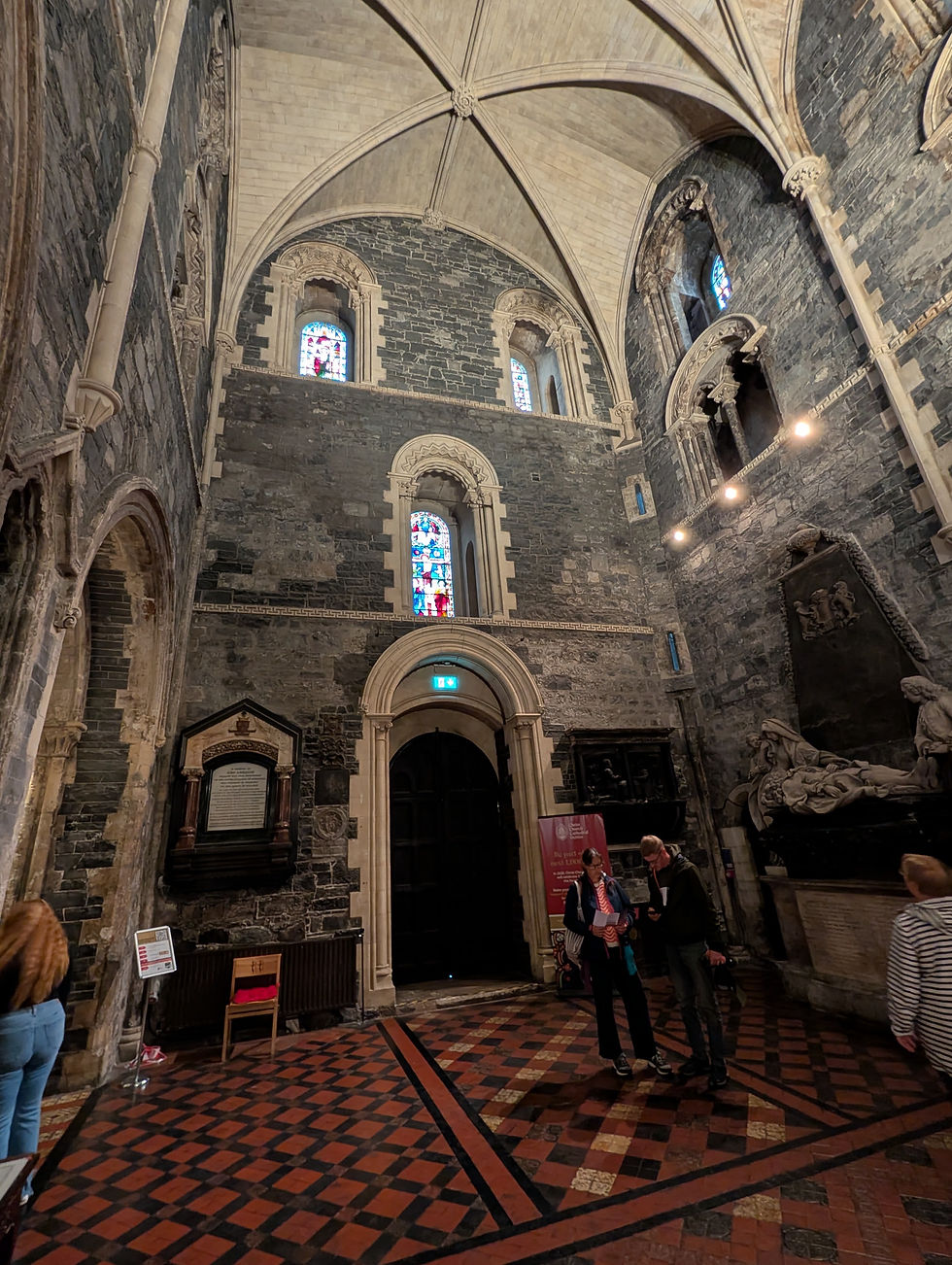
In the 12th and 13th centuries, building a cathedral was a slow process and architectural trends changed along the way. Looking at the west wall of the south transept, you can see the rounded arches of the earlier Romaneque style meeting the pointed arches of the newer Gothis style.

Also in the south transept is the tomb of Robert Fitzgerald, 19th Earl of Kildare. It shows him being mourned by his wife and son. At the top of the tomb is a plaque of a lion and a monkey. The monkey is said to represent the monkey that was a pet of the Earl's family. When a fire broke out at the Earl's home, the monkey reportedly grabbed his son and took him up onto the roof where he acted as nanny until the fire was extinguished. It's a great story, even though it may be apocryphal.
Downstairs, the crypt holds a number of interesting treasures.

The most striking are the statues of King Charles I and King Charles II along with the coat of arms of England. The extensive damage to the statues of the two kings is a telling representation of how much they were hated in Ireland.

Next to that is the tomb of John Bowes. He was a prominent judge with a reputation for being particularly harsh, which I think rather shows in his face. His tomb was cut in two and now the two halves stand side by side.
Probably its most famous treasure is that of Christ Church's copy of the Magna Carta which appears in a collection of manuscripts known as the Liber Niger or Black Book.

My favorite, and undoubtedly the oddest, display in the crypt is that of the mummified cat and rat. The story is that the cat followed a mouse into the bellows of the organ and both were trapped there when the ceiling of the cathedral collapsed. The original mouse was stolen somewhere along the way and a mummified rat now takes its place. You can still see the remaining whiskers of the cat. Okay, I know that's a bit weird, but I found it fascinating. It is said that there was oroginally a cat and a mouse, but that the mouse was stolen somewhere along the way and a mummified rat was substituted. The mind boggles. "Er, Johnny, be a good lad and run out and get us a mummified rat."
The tops of the supports of the nave are decorate with flowers and leaves but looking closely, you can spot some faces. There's even the face of a monkey. (The volunteers love to point him out - he's especially hard to find!)
On the north side of the nave, the 19th century columns feature many more faces, some of which are said to be the construction workers. One seems to have had a stroke.
The old font is now consigned to a storage area. It's a shame, because it is inlaid with beautifully colored marble.

Here are some more wonderful sights from the cathedral.




Comments