Exeter Delights
I have a taste for things a bit out of the ordinary so I set off to find the Old Exe Bridge. Built at the beginning of the 13th century, the bridge crossed the river Exe and its surrounding marsh lands. Over the centuries, however, the river has changed course, though whether that was by natural or man-made means is unknown. So now, the oldest surviving medieval bridge in England sits on dry land.

I made my way there one morning and was delighted to find that it's open to visitors. In fact, some people use it to cross the park over which it sits. As I crossed it, I was filled with a feeling of wonder that I was walking on the same stones that people walked so long ago!

At the end of the bridge are the remains of St. Edmund's Church.

The original church probably dated to around 870, and when Walter Gervase started construction of the bridge in 1190, he incorporated a newly built Chapel of St. Edmunds. In 1833 the church was rebuilt using materials from the old church. It was added to over the years and was in use until 1956 when it was demolished to make way for road improvements.


I was chuffed that I had found and explored it but had no idea where I wanted to go next, so I started walking up the hill until I stumbled upon another Exeter curiosity, The House that Moved.

It's a 15h century medieval timber-framed building famous for being physically relocated 220 feet down the road in 1961. Originally known as the Merchant House when it was located on Frog Street, it now houses a bridal shop on the ground floor with a residence above. There's a wonderful old British Pathe newsreel on YouTube showing the house being moved.
The house sits across the road from the St. Mary Steps church located – you guessed it – on a set of steps. It was built around 1150 and rebuilt in the 15h century.

Sadly, it wasn’t open so I couldn't get a look at the inside. What I did get a look at was the clock. Those who know me well know of my fascination with automata and mechanical devices. The clock of St. Mary Steps is known as the “Matthew the Miller Clock". It was built between 1619 and 1621 by local Exeter Clockmaker Matthew Hopping and features three figures.

The central seated figure is Matthew the Miller; the two side figures are his sons who are wielding pikes. The clock face that is on the tower is actually a reproduction. The original face is at the Victoria and Albert museum. When the clock strikes the hour, the figures go into their dance, so to speak.
I loved this description on the Exeter Civic Society website:
“Over the centuries since its installation the clock has been both a delight to the citizens and a source of endless frustration to the churchwardens of St Mary Steps. As with any complicated and intricate machine, the clock is prone to fits of uncooperative behaviour. The installation of an automatic winding mechanism, though saving the trouble of ascending the tower every day to wind it, has done nothing to prevent the clock from showing its independence of spirit.”
How lucky I was that that independent spirit wasn't showing that day!
After that great show, up the very old stone steps of Stepcote Hill I trod

to Fore Street which is essentially an extension of Exeter High Street. I found a plethora of independent shops and an old fashioned arcade mall.
One of the shops that I found particularly hard to resist was Frocks in Swing Time

which sells reproductions of designs from the 1930s, 40s and 50s. Just up my street! I'll have to come back and buy a dress for my weekend on Burgh Island!
I was disappointed to find that the Tuckers Hall was closed.

It was built in 1471 and was originally the Guild Hall of the woolen industry. I will definitely go back someday to see its magnificent interior and collection of items related to the wool trade. That day I had to settle for the wonderful handrail which incorporates the figure of a ram.

I walked around Exeter a bit more, visiting the Norman Gatehouse of Exeter Castle, also known as Rougemont Castle, owing to the red stone from which it is built.

It was built into the northern corner of the Roman city walls starting around 1068, following Exeter's rebellion against William the Conqueror. There isn't a path that takes you all around Exeter on or next to the Roman walls, which is a little frustrating.
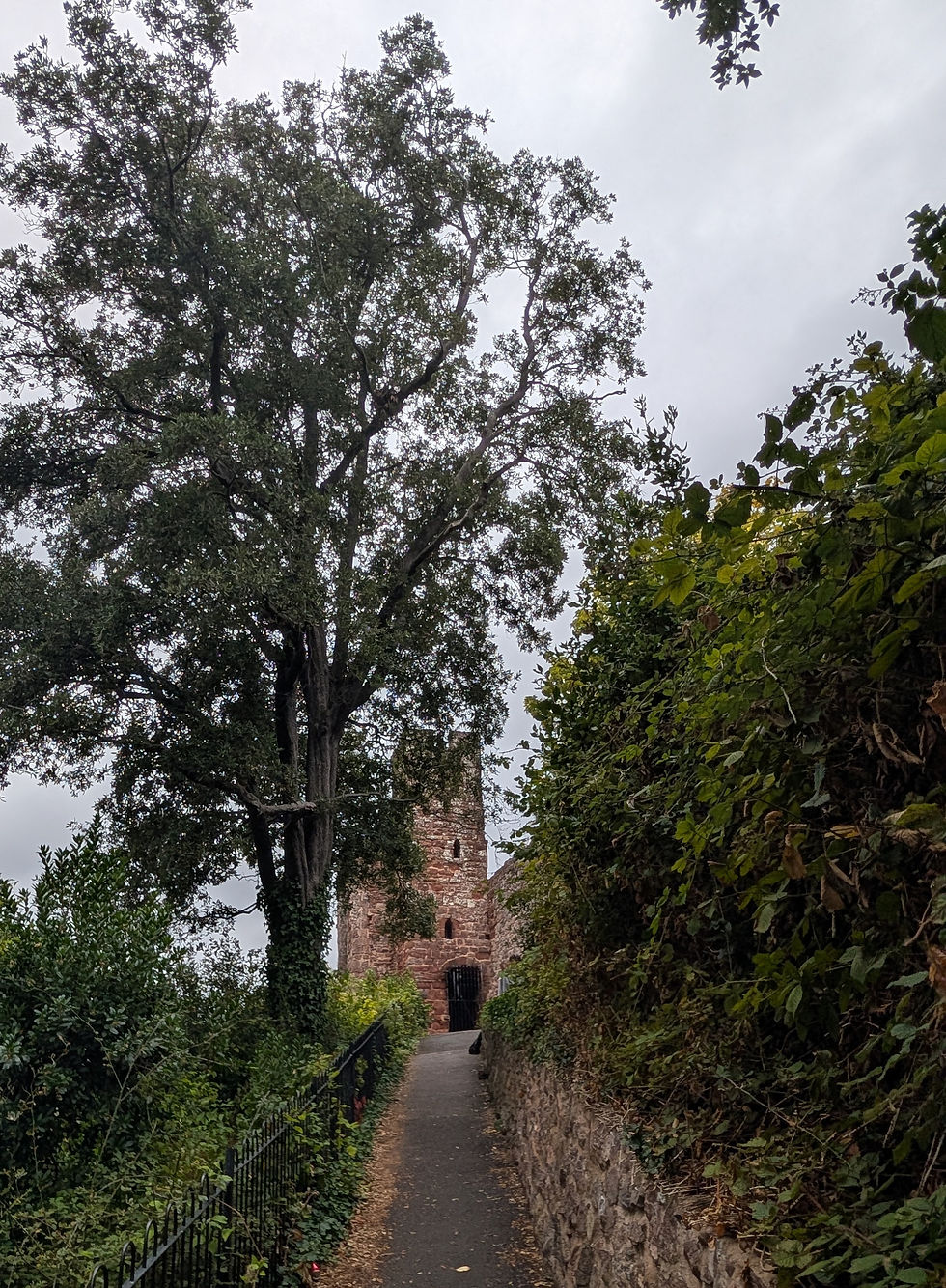
You can walk along a bit, but then there's a bit where there's no right of way. I guess there's too much of the wall that's been knocked down, unlike the Roman city walls of Chester. Too bad.
I met Bruce for a bite at Crave, a restaurant by the river. Not a very successful meal. I asked the server if the soft shell crab was battered. She said no. I ordered it and it arrived battered to within an inch of its life, resulting in a crispy thing with very little crab flavor. I might as well have ordered chicken McNuggets.
On the way back to the flat we stopped at Quayside Distillery, Floating Bar and Restaurant.

We had popped our heads in the day before and met George, the owner. We said we'd stop by to try sample some of the gins and liqueurs they make, so here we were. Te delightful combo of Rhianna and Simon were at the bar and we got to sample several really interesting things. We started with a limecello, a take on limoncello that was really lovely. Sweet, but not too sweet. We tried a couple of the flavored gins, a peppercorn and rose gin (if memory serves), quayside coastal gin made with kelp, and their flagship Exmouth Gin made with locally foraged seaweeds. Rhianna told us about a field trip the employees did to the local seaside. They were told to pick up everything they found that might be usable. They collected four different kinds of seaweed, seashells, crabshells, and who knows what else. All those items were distilled and various portions of them combined to try to find the perfect representation of the seaside.
We were having a wonderful time talking with them and Simon said, “You've been invited into the distillery.” Cool! We took our G&Ts into the next room and met Bill, the man who makes all these amazing creations. He showed us his setup and told us that he was distilling the essence of samphire at the moment. (One of my favorite things to eat, samphire is a wonderful crunchy succulent plant that grows along coastal areas and is often called sea asparagus.) He explained that he doesn't distill their gin in the traditional method using heat. Instead they have a vacuum distillation system which allows them to distill at a low temperature, thus retaining the fresh flavors of the ingredients.

When you heat distill a flavored liquid, the result tastes a bit cooked. The vacuum method results in a beautifully clean, fresh flavor. Bill's background is in chemistry and he really knows his stuff. He has little spray bottles filled with different flavors of gin; there are so many it's crazy. I said I thought a Creamsicle combination would be great. They don't have Creamsicles in the UK, but when I explained that it was orange and vanilla, he came up with two spray bottles. I sprayed one spray of each into my mouth and voila! a creamsicle. He confided that he once made a gin with the essense of smelly old shoes as a wedding present for an old roommate who used to leave his smelly old shoes in inappropriate places in their digs. We nicknamed him the evil genius and decided that the next time we were in Exeter we'd have to do a gin class with him. We wanted to buy a bottle of the flagship Exmouth Gin that we loved, but they had none left. Never fear! Bill told us to come back in an hour and he'd mix up a batch for us. He did and we did.

It was a perfect way to end our last evening in Exeter.


Fascinating! All of the post. But especially the gin information. Does the Exmouth gin really taste/smell like seaweed? How does that seem? Fresh? or slightly like the sea? Will you drink it with tonic? How about a WhatsApp call soon?