Totnes and Exeter
Considering how many times we've been to South Devon, it's unfathomable that I'd never visited Totnes. Well, I've been in Totnes, but only to catch the steam railway to Buckfastleigh, never on the high street. We were heading to Exeter but couldn't check into our flat till late afternoon, so we stopped for a wander around.

Totnes has a long recorded history, dating to 907 when its first castle was built. History is all well and good, but I love the mythology around Totnes. According to Wikipedia,
“According to the Historia Regum Britanniae written by Geoffrey of Monmouth around 1136, "the coast of Totnes" was where Brutus of Troy, the mythical founder of Britain, first came ashore on the island. Set into the pavement of Fore Street is the Brutus Stone, a small granite boulder onto which, according to local legend, Brutus first stepped from his ship. As he did so he was supposed to have declaimed:
Here I stand and here I rest. And this town shall be called Totnes.”
Of course, the place on Fore Street where the stone is set is far from where the river could have risen, even in a swelling tide. The Historia also mentions the town in a prophecy of Merlin:
"after [the dragon of Worcester] shall succeed the boar of Totness, and oppress the people with grievous tyranny. Gloucester shall send forth a lion, and shall disturb him in his cruelty, in several battles. He shall trample him under his feet, and terrify him with open jaws."
Yes, I'd certainly be disturbed.
Totnes today is a lovely place with lots of independent shops and more than its fair share of vintage clothing stores. Most vintage stores I wander into sell clothes from the 80s and 90s. I found one in Totnes however, Revival, that has the most fabulous collection of clothes and costumes from the early 20th century and even a few pieces from the 19th century. Orion, the owner, is a delightful fellow and the shop is one that I'm sure to visit again. I went a bit mad and bought a glorious embroidered silk jacket, vintage 1920s, which will be an early Christmas present to myself. Decadent? Yes. Do I regret it? Not a chance.

Some structures of note in Totnes are the East Gate Arch, the Elizabethan House Museum and Totnes Castle. The East Gate Arch was originally established around 909 CE.

It was structurally altered at a later date and was refronted in the gothic style around 1837. After a severe fire in 1990 it was rebuilt in the style you see today. There's a wonderful Totnes photographic archive you can access online with photographs that track the development of the town. Here's the East Gate Arch in 1864.

The Elizabethan House Museum was closed the day I was there but that didn't stop me admiring some of the figures on the façade.
Its website says it's full of curiosities telling the many stories of Totnes. It's open Easter till October (but not on Mondays, the day I visited) so I won't be visiting when I'm back in Devon in November. Oh well, next time.
Totnes Castle is a classic Norman motte-and-bailey castle built soon after the Norman conquest in 1066.

Though most people think of Cinderella when they hear the word castle, it was not until centuries later that castles became elegant dwellings. Their original purpose was defense.
Off we went, then, to Exeter. We'd been there before but stayed on the north side of town. This time I found a flat at the quayside – what a difference! The area around the quay is full of life and a great deal more upmarket than the north side.

We arrived late in the afternoon so just had time for a wander around and dinner. We ate at Rockfish Exeter. If it sounds like we're in a rut let me explain that Rockfish's claim to fame is expressed in their motto, “Tomorrow's fish are still in the sea.” They get their fish from Brixham fishermen each morning so their menu changes constantly. Lots of fish are listed on the placemats; the wait staff circle what's available and describe the preparations.

It's always very fresh and always very good.
The next day we took a walking tour offered by the Red Coat Guides. These are volunteers who live in Exeter and love to show visitors around and talk about the city. They tend to be retirees and are always very knowledgeable. Our guide, Dave, was wonderful.

We met in the square near the Cathedral where Dave told us about some of the interesting buildings there.
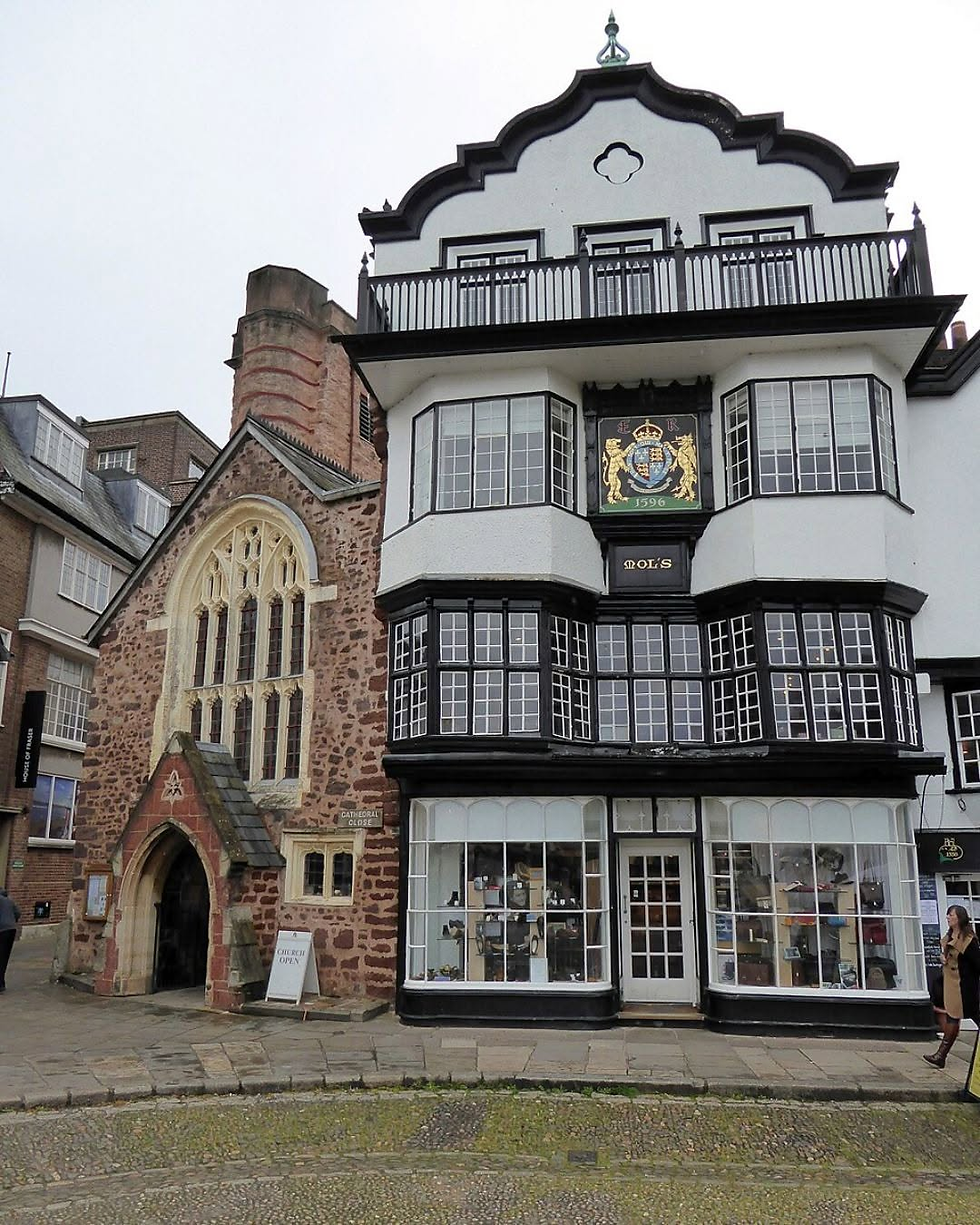
On the corner is St. Martin's Church, built in the 15th century, though the chancel arch may date from the previous church on the site built around 1065. Next to that is Mol's which was originally a custom house from the late 16th century. In 1726 it was opened as a coffee house run exclusively by women until it closed in 1829. It has had various incarnations as an art gallery, various shops and currently a whiskey store.
We walked down Cathedral Close to the elaborate carved oak door of the Deanery, which dates to circa 1600 and serves as the official residence of the Dean of Exeter.

It is said to be the inspiration for the door of the Room of Requirement in Harry Potter and the Order of the Phoenix.
Walking further down the Close we came to a stone slab built into the city wall.

This is the touchstone, so called because medieval visitors to the city were required to touch it as they entered the city. It was believed that touching the stone would dispel the evil spirits brought from the country. Just don't touch it on the way out of town!
In several parts of the city you can still see the Roman walls built around 200 CE.

Dave explained that they are so sturdy because of their construction. An outer wall is built of large stones. About three feet inside that is another wall of similar construction. Between the two of them the space is filled in with bricks laid in a herringbone pattern. Apparently that bit is covered over with cement.
Beside one of the walls is a memorial dedicated to the victims of the Luftwaffe's bombing raids in May, 1942.
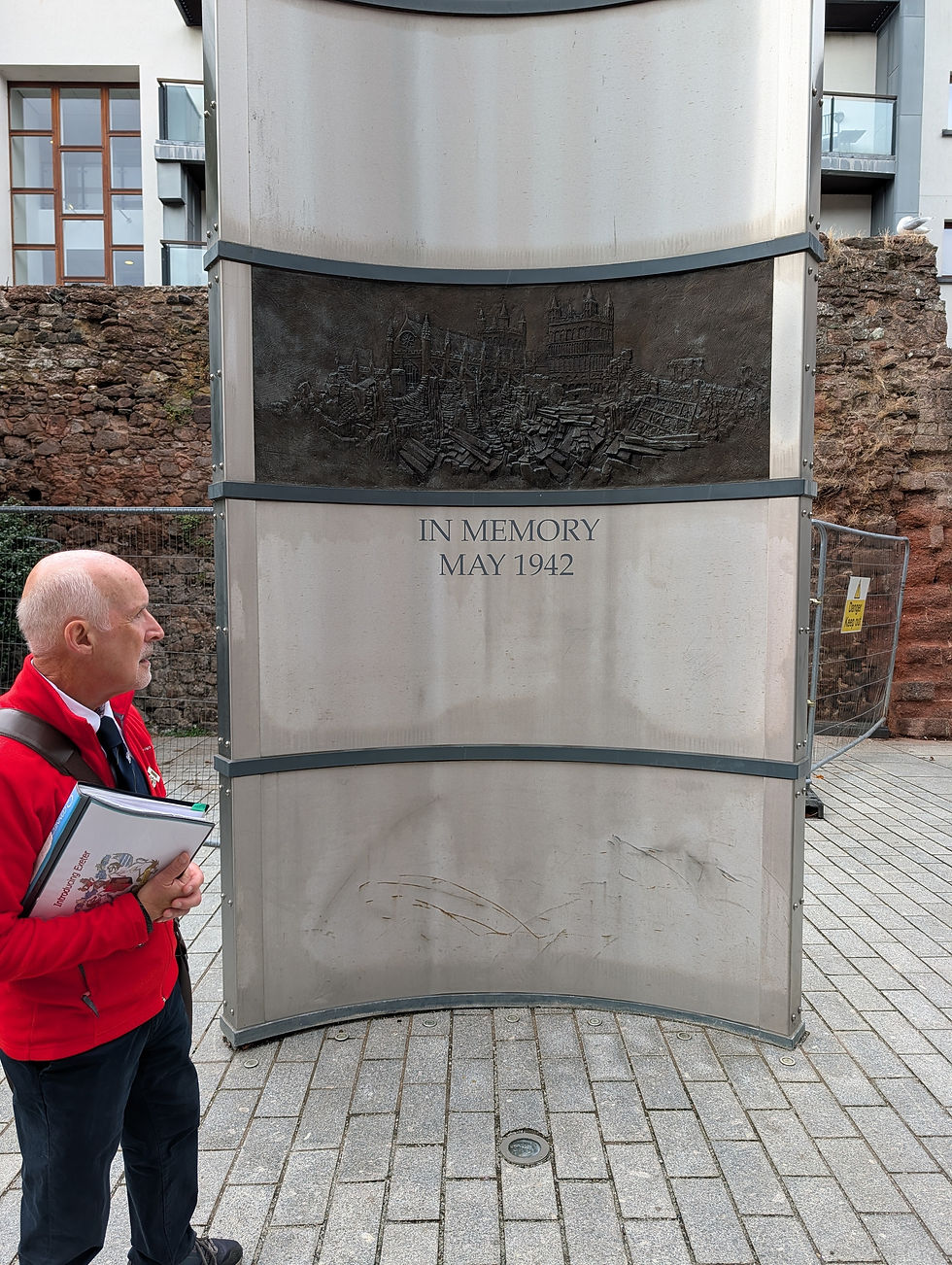
Exeter was of no strategic significance, but was bombed as retribution for the RAF bombing of Lübeck. Hitler was enraged that Lübeck, with its cathedrals and medieval city center, was targeted. In revenge, he consulted the Baedeker guide, a popular German guide book to Britain, to determine which British cities to bomb. His aim was to destroy places of historic and cultural significance. Vast swathes of the city were reduced to rubble.

Dave then led us to Exeter High Street to the Exeter Riddle, a 7-meter-tall stainless steel and stone sculpture inscribed with 10th century Old English verses from the Exeter Book.

The verses, which are riddles, are inscribed in reverse. To read them you have to look at their reflection on the adjacent side of the sculpture. The answers to the riddles are on the orbs at the bottom which must also be read in the reflection.
We stopped in front of the Guildhall which has been the center of Exeter government for over 600 years.

Though there has been a guildhall here since the 12th century, the current building dates to around 1470.
We circled back to Cathedral Square where Dave told us about the Church of St. Mary Major, now represented by only an iron cross in a stone base.

The Saxon church was built in the 7th century, refounded in 930 by King Æthelstan, burnt down by the Vikings in 1003, and rebuilt by King Canute in 1018. After the Norman conquest in 1066, Bishop William Warelwast commenced the building of a new cathedral in 1114. When the cathedral was completed around 1220, St. Mary's was vacated by the bishop and became a parish church. It was demolished in 1865, a new church was built and consecrated in 1867; it escaped the bombing of WW2 but was finally demolished in 1971. After its demolition, a Saxon graveyard was discovered on the site and below that an elaborate Roman bath house.

Over the years there have been rumblings of the site being excavated and the baths put on display to the public but the land is owned by the church and its excavation and restoration would be extraordinarily expensive. It would also be a rival tourist site, but we won't go into that.
Taking one last look at the Cathedral, Dave explained that the façade we now see, the West Front Image Screen, was added in the mid-14th century.

The bottom row of figures represent demi-angels which appear to support the architecture and figures above. The middle tier of figures represents knights and kings including Æthelstan, Edward, Cnut and Edward the Confessor. The uppermost tier is reserved for Apostles, Prophets and Divine figures. A seated figure of the Virgin Mary originally stood to the right hand of God, but was destroyed during the reformation. It was later mistakenly replaced by the figure of Richard II. In its day, it would have been painted in brilliant colors.

The tour lasted just over an hour and was so interesting that I wished it had lasted longer. Some day I'll do another walk with the Red Coats, maybe one that concentrates on the medieval era.
We enjoyed a late lunch at the Prospect Inn, a pub on the quayside built around 1803.

It's known for its food and I can see why. Bruce order a haunch of venison.

I opted for trout.

Both were perfectly prepared and so delicious. A trip to the loo revealed a quirky little aspect of the inn. Instead of a soap dispenser, there are what look like lemons mounted above the sink.
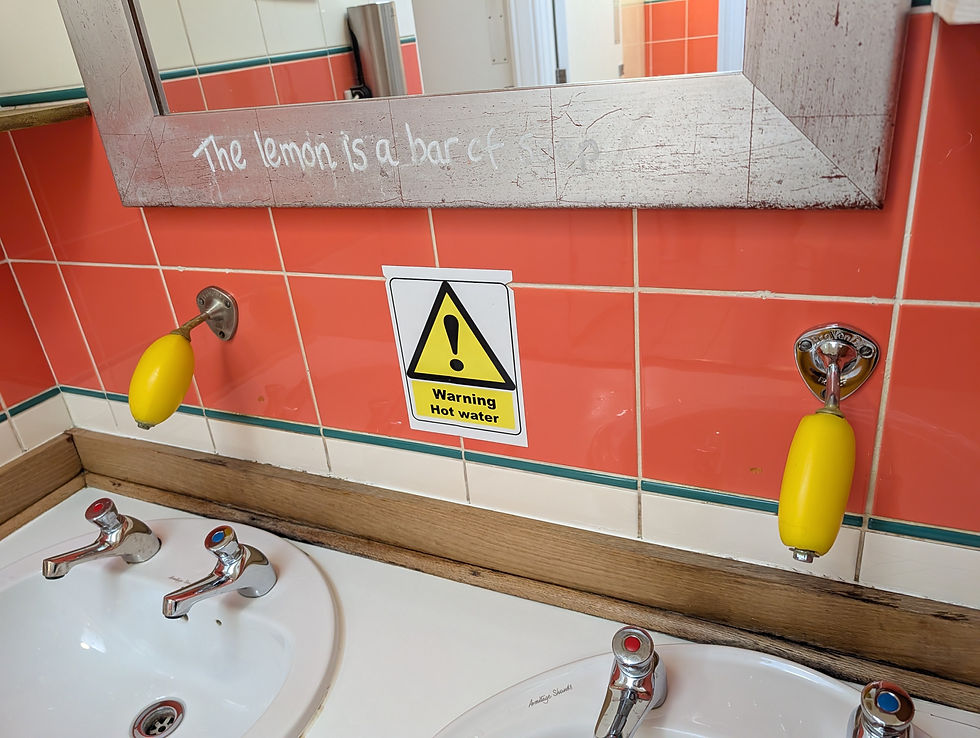
They're actually lemon-shaped soap. I don't know who thought of this or why, but I thought it was fun.
The short walk to the flat from the quayside was beautiful.

It was an all-around nice day spent in Exeter.


Comments